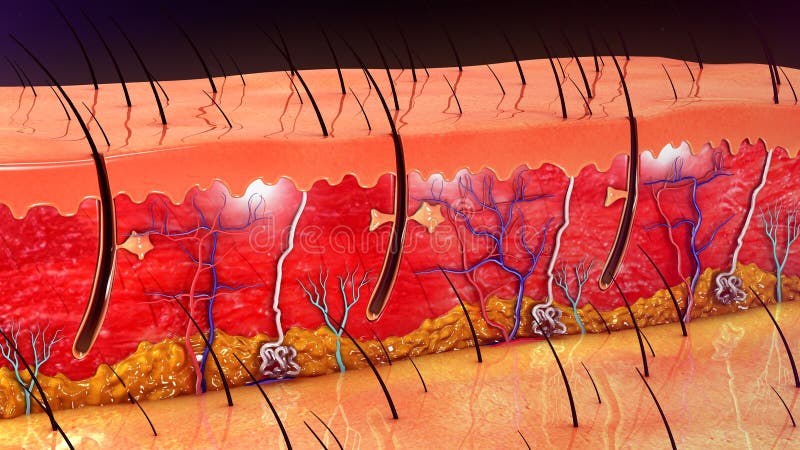
Free with trial The skin is the largest organ of the body, with a total area of about 20 square feet. The skin protects us from microbes and the elements, helps regulate body temperature, and permits the sensations of touch, heat, and cold. Skin has three layers: The epidermis, the outermost layer of skin, provides a waterproof barrier and creates our skin tone. The dermis, beneath the epidermis, contains tough connective tissue, hair follicles, and sweat glands. The deeper subcutaneous tissue (hypodermis) is made of fat and connective tissue. The skin’s color is created by special cells called melanocytes, which produce the pigment melanin. Melanocytes are located in the epidermis. Outermost stock images, royalty-free photos and pictures Skin Anatomy. The skin is the largest organ of the body, with a total area of about 20 square feet. The skin protects us from microbes and the elements, helps. The skin is the largest organ of the body, with a total area of about 20 square feet. The skin protects us from microbes and the elements, helps regulate body temperature, and permits the sensations of touch, heat, and cold. Skin has three layers: The epidermis, the outermost layer of skin, provides a waterproof barrier and creates our skin tone. The dermis, beneath the epidermis, contains tough connective tissue, hair follicles, and sweat glands. The deeper subcutaneous tissue (hypodermis) is made of fat and connective tissue. The skin’s color is created by special cells called melanocytes, which produce the pigment melanin. Melanocytes are located in the epidermis.
Free with trial The Ferenc Mora Museum, Szeged, Hungary, was built in neo classic style in 1896 - TO THE PUBLIC EDUCATION - how it is inscribed in the tympanum lying on Corinthian pillars. Right up to the staircase stands up the bust of Janos Reizner a former director of the Museum. In front of the two outermost pillars Homer and Socrates stands while on the two sides of the entrance door Cleo and Eutherpe face. Outermost stock images, royalty-free photos and pictures Mora Ferenc Museum, Szeged, Hungary. The Ferenc Mora Museum, Szeged, Hungary, was built in neo classic style in 1896 - TO THE PUBLIC EDUCATION - how it is. The Ferenc Mora Museum, Szeged, Hungary, was built in neo classic style in 1896 - TO THE PUBLIC EDUCATION - how it is inscribed in the tympanum lying on Corinthian pillars. Right up to the staircase stands up the bust of Janos Reizner a former director of the Museum. In front of the two outermost pillars Homer and Socrates stands while on the two sides of the entrance door Cleo and Eutherpe face
Free with trial A close up of a woman having a cosmetic microdermabrasion procedure. Outermost stock images, royalty-free photos and pictures Microdermabrasion cosmetic procedure. A close up of a woman having a cosmetic microdermabrasion procedure. A close up of a woman having a cosmetic microdermabrasion procedure.
Free with trial Last Call rubber stamp. Grunge design with dust scratches. Effects can be easily removed for a clean, crisp look. Color is easily changed. Outermost stock images, royalty-free photos and pictures Last Call rubber stamp. Grunge design with dust scratches. Effects can be easily removed for a clean, crisp look. Color is easily changed
Free with trial Extreme free climber. Strong free climber climbing a hard wall. Outermost stock images, royalty-free photos and pictures Extreme free climber. Strong free climber climbing a hard wall
Free with trial The skin is the largest organ of the body, with a total area of about 20 square feet. The skin protects us from microbes and the elements, helps regulate body temperature, and permits the sensations of touch, heat, and cold. Skin has three layers: The epidermis, the outermost layer of skin, provides a waterproof barrier and creates our skin tone. The dermis, beneath the epidermis, contains tough connective tissue, hair follicles, and sweat glands. The deeper subcutaneous tissue (hypodermis) is made of fat and connective tissue. The skin’s color is created by special cells called melanocytes, which produce the pigment melanin. Melanocytes are located in the epidermis. Outermost stock images, royalty-free photos and pictures Skin Anatomy. The skin is the largest organ of the body, with a total area of about 20 square feet. The skin protects us from microbes and the elements, helps. The skin is the largest organ of the body, with a total area of about 20 square feet. The skin protects us from microbes and the elements, helps regulate body temperature, and permits the sensations of touch, heat, and cold. Skin has three layers: The epidermis, the outermost layer of skin, provides a waterproof barrier and creates our skin tone. The dermis, beneath the epidermis, contains tough connective tissue, hair follicles, and sweat glands. The deeper subcutaneous tissue (hypodermis) is made of fat and connective tissue. The skin’s color is created by special cells called melanocytes, which produce the pigment melanin. Melanocytes are located in the epidermis.
Free with trial The skin is the largest organ of the body, with a total area of about 20 square feet. The skin protects us from microbes and the elements, helps regulate body temperature, and permits the sensations of touch, heat, and cold. Skin has three layers: The epidermis, the outermost layer of skin, provides a waterproof barrier and creates our skin tone. The dermis, beneath the epidermis, contains tough connective tissue, hair follicles, and sweat glands. The deeper subcutaneous tissue (hypodermis) is made of fat and connective tissue. The skin’s color is created by special cells called melanocytes, which produce the pigment melanin. Melanocytes are located in the epidermis. Outermost stock images, royalty-free photos and pictures Skin Anatomy. The skin is the largest organ of the body, with a total area of about 20 square feet. The skin protects us from microbes and the elements, helps. The skin is the largest organ of the body, with a total area of about 20 square feet. The skin protects us from microbes and the elements, helps regulate body temperature, and permits the sensations of touch, heat, and cold. Skin has three layers: The epidermis, the outermost layer of skin, provides a waterproof barrier and creates our skin tone. The dermis, beneath the epidermis, contains tough connective tissue, hair follicles, and sweat glands. The deeper subcutaneous tissue (hypodermis) is made of fat and connective tissue. The skin’s color is created by special cells called melanocytes, which produce the pigment melanin. Melanocytes are located in the epidermis.
Free with trial Last Call rubber stamp. Grunge design with dust scratches. Effects can be easily removed for a clean, crisp look. Color is easily changed. Outermost stock images, royalty-free photos and pictures Last Call rubber stamp. Grunge design with dust scratches. Effects can be easily removed for a clean, crisp look. Color is easily changed
Free with trial Justin Rose, on 1st the fairway, striking the ball with an iron, up toward the green. Crowd, blurred in the background, under the shade of the dense bush that line the edge of the outermost limits to the course. 2010 12 05 Sun City - Gary Player Golf Course. Nedbank Golf Challenge, 30th Anniversary. Lee Westwood - Winner on tournament, at the final Day. Outermost stock images, royalty-free photos and pictures Justin Rose - Iron Shot. Justin Rose, on 1st the fairway, striking the ball with an iron, up toward the green. Crowd, blurred in the background, under the shade. Justin Rose, on 1st the fairway, striking the ball with an iron, up toward the green. Crowd, blurred in the background, under the shade of the dense bush that line the edge of the outermost limits to the course. 2010 12 05 Sun City - Gary Player Golf Course. Nedbank Golf Challenge, 30th Anniversary. Lee Westwood - Winner on tournament, at the final Day.
Free with trial Tree bark texture, outermost layer of a tree trunk, seamless background, closeup view of natural wallpaper, backdrop for designing. Outermost stock images, royalty-free photos and pictures Tree bark texture, outermost layer of a tree trunk, seamless background. Closeup view of natural wallpaper, backdrop for designing
Free with trial Seamless outermost layer of mahogany tree, reddish brown hardwood tree bark texture background, closeup view of swietenia tree bark, panoramic embossed wallpaper backdrop. Outermost stock images, royalty-free photos and pictures Seamless mahogany tree bark texture, outermost layer of reddish brown tree trunk, panoramic shot. Seamless outermost layer of mahogany tree, reddish brown. Seamless outermost layer of mahogany tree, reddish brown hardwood tree bark texture background, closeup view of swietenia tree bark, panoramic embossed wallpaper backdrop
Free with trial Seamless outermost layer of tree bark with moss texture background, closeup view of natural wallpaper, abstract or backdrop for designing. Outermost stock images, royalty-free photos and pictures Seamless tree bark texture with moss, outermost layer of tree trunk abstract. Seamless outermost layer of tree bark with moss texture background, closeup view of. Seamless outermost layer of tree bark with moss texture background, closeup view of natural wallpaper, abstract or backdrop for designing
Free with trial SAN PEDRO, CALIFORNIA - 11 MAY 2022: Warehouse No. 1 is a six story warehouse built in 1917 on the outermost point of land on the main channel at the Port of Los Angeles. Outermost stock images, royalty-free photos and pictures SAN PEDRO, CALIFORNIA - 11 MAY 2022: Warehouse No. 1 is a six story warehouse built in 1917 on the outermost point of land on the. Main channel at the Port of
Free with trial Passiflora coccinea Aubl. is a perennial herbaceous vine in the family Passiflora, genus Passiflora. It has a round stem with tendrils and is 6-8 meters long. Leaves alternate, oblong to oblong in shape, apex gradually pointed, base heart-shaped, leaf margin irregularly sparsely toothed. The flower is solitary in the leaf axil, with a stem length of about 4-5 centimeters. The corolla is red, and the petals are lanceolate in shape. The tip is slightly acute and pointed, slightly drooping outward. The secondary corolla has 3 rings, with the outermost ring being longer, purple brown and scattered with spotted white. The inner two rings are white. The fleshy berry is nearly spherical and contains several seeds The seeds are flat, elongated to triangular elliptical in shape. Originating from tropical American regions such as Venezuela, Guyana, Peru, Bolivia, and Brazil. Outermost stock images, royalty-free photos and pictures The red flower of Passiflora coccinea. Passiflora coccinea Aubl. is a perennial herbaceous vine in the family Passiflora, genus Passiflora. It has a round stem. Passiflora coccinea Aubl. is a perennial herbaceous vine in the family Passiflora, genus Passiflora. It has a round stem with tendrils and is 6-8 meters long. Leaves alternate, oblong to oblong in shape, apex gradually pointed, base heart-shaped, leaf margin irregularly sparsely toothed. The flower is solitary in the leaf axil, with a stem length of about 4-5 centimeters. The corolla is red, and the petals are lanceolate in shape. The tip is slightly acute and pointed, slightly drooping outward. The secondary corolla has 3 rings, with the outermost ring being longer, purple brown and scattered with spotted white. The inner two rings are white. The fleshy berry is nearly spherical and contains several seeds The seeds are flat, elongated to triangular elliptical in shape. Originating from tropical American regions such as Venezuela, Guyana, Peru, Bolivia, and Brazil.
Free with trial Passiflora coccinea Aubl. is a perennial herbaceous vine in the family Passiflora, genus Passiflora. It has a round stem with tendrils and is 6-8 meters long. Leaves alternate, oblong to oblong in shape, apex gradually pointed, base heart-shaped, leaf margin irregularly sparsely toothed. The flower is solitary in the leaf axil, with a stem length of about 4-5 centimeters. The corolla is red, and the petals are lanceolate in shape. The tip is slightly acute and pointed, slightly drooping outward. The secondary corolla has 3 rings, with the outermost ring being longer, purple brown and scattered with spotted white. The inner two rings are white. The fleshy berry is nearly spherical and contains several seeds The seeds are flat, elongated to triangular elliptical in shape. Originating from tropical American regions such as Venezuela, Guyana, Peru, Bolivia, and Brazil. Outermost stock images, royalty-free photos and pictures The buds and red flower of Passiflora coccinea. Passiflora coccinea Aubl. is a perennial herbaceous vine in the family Passiflora, genus Passiflora. It has a. Passiflora coccinea Aubl. is a perennial herbaceous vine in the family Passiflora, genus Passiflora. It has a round stem with tendrils and is 6-8 meters long. Leaves alternate, oblong to oblong in shape, apex gradually pointed, base heart-shaped, leaf margin irregularly sparsely toothed. The flower is solitary in the leaf axil, with a stem length of about 4-5 centimeters. The corolla is red, and the petals are lanceolate in shape. The tip is slightly acute and pointed, slightly drooping outward. The secondary corolla has 3 rings, with the outermost ring being longer, purple brown and scattered with spotted white. The inner two rings are white. The fleshy berry is nearly spherical and contains several seeds The seeds are flat, elongated to triangular elliptical in shape. Originating from tropical American regions such as Venezuela, Guyana, Peru, Bolivia, and Brazil.
Free with trial Passiflora coccinea Aubl. is a perennial herbaceous vine in the family Passiflora, genus Passiflora. It has a round stem with tendrils and is 6-8 meters long. Leaves alternate, oblong to oblong in shape, apex gradually pointed, base heart-shaped, leaf margin irregularly sparsely toothed. The flower is solitary in the leaf axil, with a stem length of about 4-5 centimeters. The corolla is red, and the petals are lanceolate in shape. The tip is slightly acute and pointed, slightly drooping outward. The secondary corolla has 3 rings, with the outermost ring being longer, purple brown and scattered with spotted white. The inner two rings are white. The fleshy berry is nearly spherical and contains several seeds The seeds are flat, elongated to triangular elliptical in shape. Originating from tropical American regions such as Venezuela, Guyana, Peru, Bolivia, and Brazil. Outermost stock images, royalty-free photos and pictures The buds and red flower of Passiflora coccinea. Passiflora coccinea Aubl. is a perennial herbaceous vine in the family Passiflora, genus Passiflora. It has a. Passiflora coccinea Aubl. is a perennial herbaceous vine in the family Passiflora, genus Passiflora. It has a round stem with tendrils and is 6-8 meters long. Leaves alternate, oblong to oblong in shape, apex gradually pointed, base heart-shaped, leaf margin irregularly sparsely toothed. The flower is solitary in the leaf axil, with a stem length of about 4-5 centimeters. The corolla is red, and the petals are lanceolate in shape. The tip is slightly acute and pointed, slightly drooping outward. The secondary corolla has 3 rings, with the outermost ring being longer, purple brown and scattered with spotted white. The inner two rings are white. The fleshy berry is nearly spherical and contains several seeds The seeds are flat, elongated to triangular elliptical in shape. Originating from tropical American regions such as Venezuela, Guyana, Peru, Bolivia, and Brazil.
Free with trial This is an intricate view of a circular architectural element, possibly a dome ceiling, captured from directly below. The design features concentric rings with elaborate detailing. Radiating from the center, metal rods extend outward, reminiscent of spokes on a wheel. The central core has floral embellishments and a golden hue, providing a striking contrast to the surrounding metallic tones. The outermost ring displays a symmetrical pattern of decorative motifs. The overall impression is one of grandiosity, reflecting a fusion of industrial and ornate aesthetics. Outermost stock images, royalty-free photos and pictures Intricate Dome Ceiling Design. This is an intricate view of a circular architectural element, possibly a dome ceiling, captured from directly below. The design. This is an intricate view of a circular architectural element, possibly a dome ceiling, captured from directly below. The design features concentric rings with elaborate detailing. Radiating from the center, metal rods extend outward, reminiscent of spokes on a wheel. The central core has floral embellishments and a golden hue, providing a striking contrast to the surrounding metallic tones. The outermost ring displays a symmetrical pattern of decorative motifs. The overall impression is one of grandiosity, reflecting a fusion of industrial and ornate aesthetics.
Free with trial Silver poplar bark full of yellow lichens. Also named rhytidome is the outermost layer of stems. Outermost stock images, royalty-free photos and pictures Silver poplar bark full of yellow lichens. Also named rhytidome is the outermost layer of stems
Free with trial Eggshell is made almost entirely of calcium carbonate crystals. It is a semipermeable membrane, which means that air and moisture can pass through its pores. The shell also has a thin outermost coating called the bloom or cuticle that helps keep out bacteria and dust. Outermost stock images, royalty-free photos and pictures Eggs Shell close up. Eggshell is made almost entirely of calcium carbonate crystals. It is a semipermeable membrane, which means that air and moisture can pass. Eggshell is made almost entirely of calcium carbonate crystals. It is a semipermeable membrane, which means that air and moisture can pass through its pores. The shell also has a thin outermost coating called the bloom or cuticle that helps keep out bacteria and dust.
Free with trial Cross Section of Land Clay. Clay Cross Land Court, in which the outermost layer of the earth is observed, with the upper mantle, on which grass grows. Outermost stock images, royalty-free photos and pictures Cross Section of Land Clay. Clay Cross Land Court, in which the outermost layer of the earth is observed, with the upper mantle, on which grass grows
Free with trial Wrinkle young women fingers. The outermost layer of the skin swells when it absorbs water. It is tightly attached to the skin underneath, so it compensates for the increased area by wrinkling. Outermost stock images, royalty-free photos and pictures Wrinkle young women fingers. The outermost layer of the skin swells when it absorbs water. It is tightly attached to the skin underneath, so it compensates for. wrinkle young women fingers.The outermost layer of the skin swells when it absorbs water. It is tightly attached to the skin underneath, so it compensates for the increased area by wrinkling.
Free with trial The outermost part of the boom on an old sailing ship. Maritime surroundings. Outermost stock images, royalty-free photos and pictures Detail of an old sailing ship. Summer and sea. The outermost part of the boom on an old sailing ship. Maritime surroundings. The outermost part of the boom on an old sailing ship. Maritime surroundings.
Free with trial High Altitude view of the Atlantic Ocean and Massachusetts Coast in New England. Outermost stock images, royalty-free photos and pictures Aerial at Orleans, Cape Cod Showing Nauset Beach and the Site of the Outermost House. High Altitude view of the Atlantic Ocean and Massachusetts Coast in New. High Altitude view of the Atlantic Ocean and Massachusetts Coast in New England
Free with trial Strawberry disease sepals, Sepals are legal parts of the flower, located in the outermost whorl of the flower. Fungus and disease spots. Outermost stock images, royalty-free photos and pictures Strawberry disease sepals, Sepals are legal parts of the flower, located in the outermost whorl of the flower. Fungus and disease. Spots
Free with trial The image presents a digital illustration of a flower, composed of multiple petals in a gradient of colors. The petals are arranged in a circular pattern, with the outermost petals being a vibrant orange, transitioning into a soft pink, followed by a cool blue, and finally culminating in a warm purple. The flower is set against a dark gray background, which accentuates the colors and creates a striking contrast. The flower appears to be a stylized representation of a flower, rather than a photograph of a real flower. Outermost stock images, royalty-free photos and pictures A digital illustration of a flower with petals in various colors. The image presents a digital illustration of a flower, composed of multiple petals in a. The image presents a digital illustration of a flower, composed of multiple petals in a gradient of colors. The petals are arranged in a circular pattern, with the outermost petals being a vibrant orange, transitioning into a soft pink, followed by a cool blue, and finally culminating in a warm purple. The flower is set against a dark gray background, which accentuates the colors and creates a striking contrast. The flower appears to be a stylized representation of a flower, rather than a photograph of a real flower.
Free with trial Provincetown,Massachusetts,USA - September 13, 2016: Pilgrim Bartholomew Gosnold initially named what is now known as Provincetown, “Shoal Hope” when the Mayflower set ashore here on the outermost tip of Cape Cod in 1602. But later that day after a bountiful catch of codfish, renamed it Cape Cod, which now refers to the entire area of land that juts out like an arm, divided from the mainland. Outermost stock images, royalty-free photos and pictures Tower in Provincetown, Massachusetts. Provincetown,Massachusetts,USA - September 13, 2016: Pilgrim Bartholomew Gosnold initially named what is now known as. Provincetown,Massachusetts,USA - September 13, 2016: Pilgrim Bartholomew Gosnold initially named what is now known as Provincetown, “Shoal Hope” when the Mayflower set ashore here on the outermost tip of Cape Cod in 1602. But later that day after a bountiful catch of codfish, renamed it Cape Cod, which now refers to the entire area of land that juts out like an arm, divided from the mainland
Free with trial This graceful blue iris was photographed at Meadowlark Botanical Gardens in Va just after a heavy rain. A springtime flower, the delicate petals are open to fully expose yellow throats on the outermost petals. Named after the greek goddess of the rainbow, this stunning iris is shown with raindrops captured in the center and on the leaves. Outermost stock images, royalty-free photos and pictures Blue Iris Flower Raindrops Garden Virginia. This graceful blue iris was photographed at Meadowlark Botanical Gardens in Va just after a heavy rain. A springtime. This graceful blue iris was photographed at Meadowlark Botanical Gardens in Va just after a heavy rain. A springtime flower, the delicate petals are open to fully expose yellow throats on the outermost petals. Named after the greek goddess of the rainbow, this stunning iris is shown with raindrops captured in the center and on the leaves.
Free with trial The skin is the largest organ of the body, with a total area of about 20 square feet. The skin protects us from microbes and the elements, helps regulate body temperature, and permits the sensations of touch, heat, and cold. Skin has three layers: The epidermis, the outermost layer of skin, provides a waterproof barrier and creates our skin tone. The dermis, beneath the epidermis, contains tough connective tissue, hair follicles, and sweat glands. The deeper subcutaneous tissue (hypodermis) is made of fat and connective tissue. The skin’s color is created by special cells called melanocytes, which produce the pigment melanin. Melanocytes are located in the epidermis. Outermost stock images, royalty-free photos and pictures Skin Anatomy. The skin is the largest organ of the body, with a total area of about 20 square feet. The skin protects us from microbes and the elements, helps. The skin is the largest organ of the body, with a total area of about 20 square feet. The skin protects us from microbes and the elements, helps regulate body temperature, and permits the sensations of touch, heat, and cold. Skin has three layers: The epidermis, the outermost layer of skin, provides a waterproof barrier and creates our skin tone. The dermis, beneath the epidermis, contains tough connective tissue, hair follicles, and sweat glands. The deeper subcutaneous tissue (hypodermis) is made of fat and connective tissue. The skin’s color is created by special cells called melanocytes, which produce the pigment melanin. Melanocytes are located in the epidermis.
Free with trial Bark texture. Tree bark texture close-up with moss and fractures. Outermost stock images, royalty-free photos and pictures Bark texture. Tree bark texture close-up with moss and fractures
Free with trial North Cyprus Karpazi -. Rizokarpaso Cape, Karpass, Cyprus - goat bite on a tree in the bush. Outermost stock images, royalty-free photos and pictures North Cyprus Karpazi -. Rizokarpaso Cape, Karpass, Cyprus - goat bite on a tree in the bush
Free with trial North Cyprus Karpazi. Extreme point of Northern Cyprus, Karpaz. - Rizokarpaso Cape, Karpass, Cyprus. Outermost stock images, royalty-free photos and pictures North Cyprus Karpazi. Extreme point of Northern Cyprus, Karpaz. - Rizokarpaso Cape, Karpass, Cyprus
Free with trial A YURT is transportable collapsible dwelling that came to us from ancient times,It consists of wooden framework, covered with felt. The framework forms walls of the dwelling made of latticed wooden poles,Depending on the air temperature the yurt is covered with two if not mor layers of felt. The outermost layer is coated with flat for it to be impenetrable for rain or snow. the photo is in the Hexi Corridor ,silk road ,Kazak Autonomous County,gansu china. Outermost stock images, royalty-free photos and pictures Yurts. A YURT is transportable collapsible dwelling that came to us from ancient times,It consists of wooden framework, covered with felt. The framework forms. A YURT is transportable collapsible dwelling that came to us from ancient times,It consists of wooden framework, covered with felt. The framework forms walls of the dwelling made of latticed wooden poles,Depending on the air temperature the yurt is covered with two if not mor layers of felt. The outermost layer is coated with flat for it to be impenetrable for rain or snow. the photo is in the Hexi Corridor ,silk road ,Kazak Autonomous County,gansu china
Free with trial North Cyprus Karpazi panorama. Extreme point of Northern Cyprus, Karpaz. - National park. Outermost stock images, royalty-free photos and pictures North Cyprus Karpazi panorama. Extreme point of Northern Cyprus, Karpaz. - National park
Free with trial North Cyprus Karpazi - Cape Zafer. Extreme point of Northern Cyprus, Karpaz. - Zafer Adlari (Kleides Islands) from Cape Zafer. Outermost stock images, royalty-free photos and pictures North Cyprus Karpazi - Cape Zafer. Extreme point of Northern Cyprus, Karpaz. - Zafer Adlari (Kleides Islands) from Cape Zafer
Free with trial Goats on the coast - Photography was taken in Karpass , Turkish Republic of Northern Cyprus. Outermost stock images, royalty-free photos and pictures North Cyprus Karpazi - Goats on the coast. Goats on the coast - Photography was taken in Karpass , Turkish Republic of Northern Cyprus. Goats on the coast - Photography was taken in Karpass , Turkish Republic of Northern Cyprus.
Free with trial Is a small passerine bird in the tit family Paridae. The Eurasian blue tit (Cyanistes caeruleus[2]) is a small passerine bird in the tit family Paridae. The bird is easily recognisable by its blue and yellow plumage and its size. Eurasian blue tits, usually resident and non-migratory birds, are widespread and a common resident breeder throughout temperate and subarctic Europe and western Asia in deciduous or mixed woodlands with a high proportion of oak. They usually nest in tree holes, although they easily adapt to nest boxes where necessary. Their main rival for nests and in the search for food is the larger great tit. The Eurasian blue tit prefers insects and spiders for its diet. Outside the breeding season, they also eat seeds and other vegetable-based foods. The birds are famed for their skill, as they can cling to the outermost branches and hang upside down when looking for food. Outermost stock images, royalty-free photos and pictures BlueTit in denmark. Is a small passerine bird in the tit family Paridae.The Eurasian blue tit (Cyanistes caeruleus[2]) is a small passerine bird in the. Is a small passerine bird in the tit family Paridae.The Eurasian blue tit (Cyanistes caeruleus[2]) is a small passerine bird in the tit family Paridae. The bird is easily recognisable by its blue and yellow plumage and its size. Eurasian blue tits, usually resident and non-migratory birds, are widespread and a common resident breeder throughout temperate and subarctic Europe and western Asia in deciduous or mixed woodlands with a high proportion of oak. They usually nest in tree holes, although they easily adapt to nest boxes where necessary. Their main rival for nests and in the search for food is the larger great tit. The Eurasian blue tit prefers insects and spiders for its diet. Outside the breeding season, they also eat seeds and other vegetable-based foods. The birds are famed for their skill, as they can cling to the outermost branches and hang upside down when looking for food.
Free with trial Wire Tailed Swallow (Hirundo smithii) during early morning. This species gets its name from the very long filamentous outermost tail feathers, which trail behind like two wires. Outermost stock images, royalty-free photos and pictures Wire-tailed swallow (Hirundo smithii). Wire Tailed Swallow (Hirundo smithii) during early morning. This species gets its name from the very. Wire Tailed Swallow (Hirundo smithii) during early morning. This species gets its name from the very long filamentous outermost tail feathers, which trail behind like two wires.
Free with trial Boh Tea Garden located at Sungai Palas Tea Plantation at Cemeron Highlands, Pahang, Malaysia. Outermost stock images, royalty-free photos and pictures Boh Tea Garden. Located at Sungai Palas Tea Plantation at Cemeron Highlands, Pahang, Malaysia
Free with trial Blåmejsen is widespread in most of Europe. The Eurasian blue tit (Cyanistes caeruleus[2]) is a small passerine bird in the tit family Paridae. The bird is easily recognisable by its blue and yellow plumage and its size. Eurasian blue tits, usually resident and non-migratory birds, are widespread and a common resident breeder throughout temperate and subarctic Europe and western Asia in deciduous or mixed woodlands with a high proportion of oak. They usually nest in tree holes, although they easily adapt to nest boxes where necessary. Their main rival for nests and in the search for food is the larger great tit. The Eurasian blue tit prefers insects and spiders for its diet. Outside the breeding season, they also eat seeds and other vegetable-based foods. The birds are famed for their skill, as they can cling to the outermost branches and hang upside down when looking for food. Outermost stock images, royalty-free photos and pictures BlueTit denmark. Blåmejsen is widespread in most of Europe.The Eurasian blue tit (Cyanistes caeruleus[2]) is a small passerine bird in the tit family. Blåmejsen is widespread in most of Europe.The Eurasian blue tit (Cyanistes caeruleus[2]) is a small passerine bird in the tit family Paridae. The bird is easily recognisable by its blue and yellow plumage and its size. Eurasian blue tits, usually resident and non-migratory birds, are widespread and a common resident breeder throughout temperate and subarctic Europe and western Asia in deciduous or mixed woodlands with a high proportion of oak. They usually nest in tree holes, although they easily adapt to nest boxes where necessary. Their main rival for nests and in the search for food is the larger great tit. The Eurasian blue tit prefers insects and spiders for its diet. Outside the breeding season, they also eat seeds and other vegetable-based foods. The birds are famed for their skill, as they can cling to the outermost branches and hang upside down when looking for food.
Free with trial Nauset Marsh Aerial at Eastham, Cape Cod. Zoom in to Atlantic Ocean and Beach in New England. Outermost stock images, royalty-free photos and pictures Nauset Marsh Aerial at Eastham, Cape Cod. Zoom in to Atlantic Ocean and Beach in New England
Free with trial Last Call rubber stamp. Grunge design with dust scratches. Effects can be easily removed for a clean, crisp look. Color is easily changed. Outermost stock images, royalty-free photos and pictures Last Call rubber stamp. Grunge design with dust scratches. Effects can be easily removed for a clean, crisp look. Color is easily changed
Free with trial Aerial at Eastham, Cape Cod Showing Nauset Beach Lighthouse. High Altitude view of the Atlantic Ocean and Massachusetts Coast in New England. Outermost stock images, royalty-free photos and pictures Aerial at Eastham, Cape Cod Showing Nauset Beach Lighthouse. High Altitude view of the Atlantic Ocean and Massachusetts Coast in New England
Free with trial A macro closeup of a blue mountain cornflower. A blossom with interesting outermost ray florets. Outermost stock images, royalty-free photos and pictures Blue mountain cornflower centaurea montana. A macro closeup of a blue mountain cornflower. A blossom with interesting outermost ray florets. A macro closeup of a blue mountain cornflower. A blossom with interesting outermost ray florets.
Free with trial A picture of a saturn with a white background. AI generated. Outermost stock images, royalty-free photos and pictures A picture of a saturn with a white background. AI generated
Free with trial Last Call rubber stamp. Grunge design with dust scratches. Effects can be easily removed for a clean, crisp look. Color is easily changed. Outermost stock images, royalty-free photos and pictures Last Call rubber stamp. Grunge design with dust scratches. Effects can be easily removed for a clean, crisp look. Color is easily changed
Free with trial A painting of a yin and yang symbol on a black background. Generative AI. A painting of a yin and yang symbol on a black background AI generated. Outermost stock images, royalty-free photos and pictures A painting of a yin and yang symbol on a black background. Generative AI. A painting of a yin and yang symbol on a black background AI generated
Free with trial A close up of an eye with a blue and pink iris. AI generated. Outermost stock images, royalty-free photos and pictures A close up of an eye with a blue and pink iris. AI generated
Free with trial Last Call rubber stamp. Grunge design with dust scratches. Effects can be easily removed for a clean, crisp look. Color is easily changed. Outermost stock images, royalty-free photos and pictures Last Call rubber stamp. Grunge design with dust scratches. Effects can be easily removed for a clean, crisp look. Color is easily changed
Free with trial A close up of an eye with a yellow iris. AI generated. Outermost stock images, royalty-free photos and pictures A close up of an eye with a yellow iris. AI generated
Free with trial Aerial at Chatham, Cape Cod Showing Monomoy and Nantucket Sound. High Altitude view of the Atlantic Ocean and Massachusetts Coast in New England. Outermost stock images, royalty-free photos and pictures Aerial at Chatham, Cape Cod Showing Monomoy and Nantucket Sound. High Altitude view of the Atlantic Ocean and Massachusetts Coast in New England
Free with trial Aerial at Orleans, Cape Cod Showing Nauset Beach and the North Beach Inlet. High Altitude view of the Atlantic Ocean and Massachusetts Coast in New England. Outermost stock images, royalty-free photos and pictures Aerial at Orleans, Cape Cod Showing Nauset Beach and the North Beach Inlet. High Altitude view of the Atlantic Ocean and Massachusetts Coast in New England
Free with trial Last Call rubber stamp. Grunge design with dust scratches. Effects can be easily removed for a clean, crisp look. Color is easily changed. Outermost stock images, royalty-free photos and pictures Last Call rubber stamp. Grunge design with dust scratches. Effects can be easily removed for a clean, crisp look. Color is easily changed
Free with trial Aerial at Chatham, Cape Cod Showing the Lighthouse and Coast Guard Station. High Altitude view of the Atlantic Ocean and Massachusetts Coast in New England. Outermost stock images, royalty-free photos and pictures Aerial at Chatham, Cape Cod Showing the Lighthouse and Coast Guard Station. High Altitude view of the Atlantic Ocean and Massachusetts Coast in New England
Free with trial A red and black spiral galaxy with stars in the background. AI generated. Outermost stock images, royalty-free photos and pictures A red and black spiral galaxy with stars in the background. AI generated
Free with trial A painting of a yin and yang symbol in the middle of a colorful swirl. Generative AI. Outermost stock images, royalty-free photos and pictures A painting of a yin and yang symbol in the middle of a colorful swirl. Generative AI. A painting of a yin and yang symbol in the middle of a colorful swirl AI
Free with trial Skin is a kind of soy products. Outermost stock images, royalty-free photos and pictures Skin is a kind of soy products.
Free with trial A cross section of a plant cell. AI generated. Outermost stock images, royalty-free photos and pictures A cross section of a plant cell. AI generated
Free with trial Last Call rubber stamp. Grunge design with dust scratches. Effects can be easily removed for a clean, crisp look. Color is easily changed. Outermost stock images, royalty-free photos and pictures Last Call rubber stamp. Grunge design with dust scratches. Effects can be easily removed for a clean, crisp look. Color is easily changed
Free with trial Last Call rubber stamp. Grunge design with dust scratches. Effects can be easily removed for a clean, crisp look. Color is easily changed. Outermost stock images, royalty-free photos and pictures Last Call rubber stamp. Grunge design with dust scratches. Effects can be easily removed for a clean, crisp look. Color is easily changed
Free with trial Robert Allenby, iron shot up to the green, 1st fairway, last day of the tournament. Crowd, blurred in the background, under the shade of the trees that line the edge of the outermost limits to the fairway. 2010 12 04 Sun City - Gary Player Golf Course. Nedbank Golf Challenge, 30th Anniversary. Lee Westwood - Winner on tournament, at the final Day. Outermost stock images, royalty-free photos and pictures Robert Allenby. Iron shot up to the green, 1st fairway, last day of the tournament. Crowd, blurred in the background, under the shade of the trees that line. Robert Allenby, iron shot up to the green, 1st fairway, last day of the tournament. Crowd, blurred in the background, under the shade of the trees that line the edge of the outermost limits to the fairway. 2010 12 04 Sun City - Gary Player Golf Course. Nedbank Golf Challenge, 30th Anniversary. Lee Westwood - Winner on tournament, at the final Day.
Free with trial Justin Rose, on 1st the fairway, striking the ball with an iron, up toward the green. Crowd, blurred in the background, under the shade of the dense bush that line the edge of the outermost limits to the course. 2010 12 05 Sun City - Gary Player Golf Course. Nedbank Golf Challenge, 30th Anniversary. Lee Westwood - Winner on tournament, at the final Day. Outermost stock images, royalty-free photos and pictures Justin Rose - Fairway Drive. Justin Rose, on 1st the fairway, striking the ball with an iron, up toward the green. Crowd, blurred in the background, under the. Justin Rose, on 1st the fairway, striking the ball with an iron, up toward the green. Crowd, blurred in the background, under the shade of the dense bush that line the edge of the outermost limits to the course. 2010 12 05 Sun City - Gary Player Golf Course. Nedbank Golf Challenge, 30th Anniversary. Lee Westwood - Winner on tournament, at the final Day.
Free with trial The Needles, Isle of Wight, England, UK. September 2019. The Needles lighthouse with helipad situated on the outermost chalk rocks. Passengers on a rib viewing the rocks and lighthouse. Isle of Wight, UK. Outermost stock images, royalty-free photos and pictures The Needles lighthouse, Isle of Wight, UK. The Needles, Isle of Wight, England, UK. September 2019. The Needles lighthouse with helipad situated on the outermost. The Needles, Isle of Wight, England, UK. September 2019. The Needles lighthouse with helipad situated on the outermost chalk rocks. Passengers on a rib viewing the rocks and lighthouse. Isle of Wight, UK
Free with trial The outermost edge of the tropical forest. Outermost stock images, royalty-free photos and pictures The outermost edge of the tropical forest
Free with trial Natural texture of old bark, natural texture of the outermost part of old wood. Outermost stock images, royalty-free photos and pictures Natural texture of old bark, natural texture of the outermost part of old wood
Free with trial The outermost layer of Dipterocarpus plywood. Outermost stock images, royalty-free photos and pictures The outermost layer of Dipterocarpus plywood
Free with trial Natural texture of old bark, natural texture of the outermost part of old wood. Outermost stock images, royalty-free photos and pictures Natural texture of old bark, natural texture of the outermost part of old wood
Free with trial Corona The outermost layer of a star's atmosphere, extending i. Nto space, isolated on white background, photo va. Outermost stock images, royalty-free photos and pictures Corona The outermost layer of a star's atmosphere, extending i. Nto space, isolated on white background, photo va
Free with trial Bark tree texture background, Bark is outermost layers of stems and roots of woody plants. It refers to all tissues outside the vascular cambium and a nontechnical term. Outer bark in older stems. Outermost stock images, royalty-free photos and pictures Bark tree texture background, Bark is outermost layers of stems and roots of woody. Plants. It refers to all tissues outside the vascular cambium and a. Bark tree texture background, Bark is outermost layers of stems and roots of woody plants. It refers to all tissues outside the vascular cambium and a nontechnical term. Outer bark in older stems
Free with trial Topside, also known as Gandik or the outermost part of the beef& x27;s hind leg, is used for various dishes that require long cooking times such as rendang, dendeng, and empal due to its dense texture and low fat content, but is also suitable for grilled meats, thin stir-fries, and soupy dishes such as soto and rawon. Outermost stock images, royalty-free photos and pictures Topside, also known as Gandik or the outermost part of the beef& x27;s hind leg, is used for various dishes that require long. Cooking times such as rendang. Topside, also known as Gandik or the outermost part of the beef& x27;s hind leg, is used for various dishes that require long cooking times such as rendang, dendeng, and empal due to its dense texture and low fat content, but is also suitable for grilled meats, thin stir-fries, and soupy dishes such as soto and rawon.
Free with trial Outer envelope the outermost layer of a star where stellar win. Ds originate k uhd very det. Outermost stock images, royalty-free photos and pictures Outer envelope the outermost layer of a star where stellar win. Ds originate k uhd very det
Free with trial Outer Envelope The outermost layer of a star, where stellar wi. Nds originate, on white background, photo vf. Outermost stock images, royalty-free photos and pictures Outer Envelope The outermost layer of a star, where stellar wi. Nds originate, on white background, photo vf
Free with trial A highresolution image of a red cells outermost layer the cell membrane demonstrating its semipermeable nature and how. It interacts AI generated. Outermost stock images, royalty-free photos and pictures A highresolution image of a red cells outermost layer the cell membrane demonstrating its semipermeable nature and how. It interacts AI generated
Free with trial Bark tree texture background, Bark is outermost layers of stems and roots of woody plants. It refers to all tissues outside the vascular cambium and a nontechnical term. Outer bark in older stems. Outermost stock images, royalty-free photos and pictures Bark tree texture background, Bark is outermost layers of stems and roots of woody. Plants. It refers to all tissues outside the vascular cambium and a. Bark tree texture background, Bark is outermost layers of stems and roots of woody plants. It refers to all tissues outside the vascular cambium and a nontechnical term. Outer bark in older stems
Free with trial The egg shell is the outermost layer of the egg. This layer can have a hard or soft texture, depending on the type of egg. Outermost stock images, royalty-free photos and pictures The egg shell is the outermost layer of the egg. This layer can have a hard or soft texture, depending on the type of egg.
Free with trial TrunkTree bark is the outermost layer of a tree& x27;s trunk, which acts as a natural protective barrier. Its texture is generally rough, fibrous, and has an irregular groove pattern. The color of the bark can vary from dark brown to gray to light brown, depending on the tree species. Some trees have cracked, forming vertical lines or raised scaly patterns. Other tree species have smoother bark, but still exhibit grain lines or slight ridges. The bark of older trees is typically thicker and harder, while younger trees have thinner, softer bark. Outermost stock images, royalty-free photos and pictures Trunk tree. TrunkTree bark is the outermost layer of a tree& x27;s trunk, which acts as a natural protective barrier. Its texture is generally rough, fibrous. TrunkTree bark is the outermost layer of a tree& x27;s trunk, which acts as a natural protective barrier. Its texture is generally rough, fibrous, and has an irregular groove pattern. The color of the bark can vary from dark brown to gray to light brown, depending on the tree species. Some trees have cracked, forming vertical lines or raised scaly patterns. Other tree species have smoother bark, but still exhibit grain lines or slight ridges. The bark of older trees is typically thicker and harder, while younger trees have thinner, softer bark.
Free with trial King Tutankhamun galleries at the Grand Egyptian Museum in Giza, Egypt. The outermost gilded wood coffin of the ancient Egyptian Pharaoh Tutankhamun on display. Outermost stock images, royalty-free photos and pictures King Tutankhamun galleries at the Grand Egyptian Museum in Giza, Egypt. The outermost gilded wood coffin of the ancient Egyptian Pharaoh Tutankhamun on display
Free with trial Silver poplar bark with some yellow lichens. Also named rhytidome is the outermost layer of stems. Outermost stock images, royalty-free photos and pictures Silver poplar bark with some yellow lichens. Also named rhytidome is the outermost layer of stems
Free with trial Upperside of both sexes brown of varying depths of colour. Forewing: cell with one pair of subbasal and one pair of apical transverse sinuous fasciae, the outermost defining the discocellulars a short, broad, dark, oblique fascia beyond to vein 4, its inner margin diffuse, its outer sinuous but sharply defined below vein 4 a sinuous, transverse, more faint fascia, followed by a discal blackish fascia, very broad and diffuse, below costa, bordered by a row of faint ocelli, and a postdiscal and a subterminal similar fascia following the outline of the termen. Hindwing with a slender blackish loop near apex of cellular area a broad inwardly diffuse, outwardly well-defined short discal fascia in continuation of the one on the forewing a series of postdiscal somewhat ochraceous ocelli with black pupils minutely centred with white postdiscal and subterminal broad lines as on the forewing. Outermost stock images, royalty-free photos and pictures Junonia iphita. Upperside of both sexes brown of varying depths of colour. Forewing: cell with one pair of subbasal and one pair of apical transverse sinuous. Upperside of both sexes brown of varying depths of colour. Forewing: cell with one pair of subbasal and one pair of apical transverse sinuous fasciae, the outermost defining the discocellulars a short, broad, dark, oblique fascia beyond to vein 4, its inner margin diffuse, its outer sinuous but sharply defined below vein 4 a sinuous, transverse, more faint fascia, followed by a discal blackish fascia, very broad and diffuse, below costa, bordered by a row of faint ocelli, and a postdiscal and a subterminal similar fascia following the outline of the termen. Hindwing with a slender blackish loop near apex of cellular area a broad inwardly diffuse, outwardly well-defined short discal fascia in continuation of the one on the forewing a series of postdiscal somewhat ochraceous ocelli with black pupils minutely centred with white postdiscal and subterminal broad lines as on the forewing
Free with trial Passiflora coccinea Aubl. is a perennial herbaceous vine in the family Passiflora, genus Passiflora. It has a round stem with tendrils and is 6-8 meters long. Leaves alternate, oblong to oblong in shape, apex gradually pointed, base heart-shaped, leaf margin irregularly sparsely toothed. The flower is solitary in the leaf axil, with a stem length of about 4-5 centimeters. The corolla is red, and the petals are lanceolate in shape. The tip is slightly acute and pointed, slightly drooping outward. The secondary corolla has 3 rings, with the outermost ring being longer, purple brown and scattered with spotted white. The inner two rings are white. The fleshy berry is nearly spherical and contains several seeds The seeds are flat, elongated to triangular elliptical in shape. Originating from tropical American regions such as Venezuela, Guyana, Peru, Bolivia, and Brazil. Outermost stock images, royalty-free photos and pictures The buds and red flower of Passiflora coccinea. Passiflora coccinea Aubl. is a perennial herbaceous vine in the family Passiflora, genus Passiflora. It has a. Passiflora coccinea Aubl. is a perennial herbaceous vine in the family Passiflora, genus Passiflora. It has a round stem with tendrils and is 6-8 meters long. Leaves alternate, oblong to oblong in shape, apex gradually pointed, base heart-shaped, leaf margin irregularly sparsely toothed. The flower is solitary in the leaf axil, with a stem length of about 4-5 centimeters. The corolla is red, and the petals are lanceolate in shape. The tip is slightly acute and pointed, slightly drooping outward. The secondary corolla has 3 rings, with the outermost ring being longer, purple brown and scattered with spotted white. The inner two rings are white. The fleshy berry is nearly spherical and contains several seeds The seeds are flat, elongated to triangular elliptical in shape. Originating from tropical American regions such as Venezuela, Guyana, Peru, Bolivia, and Brazil.
Free with trial Passiflora coccinea Aubl. is a perennial herbaceous vine in the family Passiflora, genus Passiflora. It has a round stem with tendrils and is 6-8 meters long. Leaves alternate, oblong to oblong in shape, apex gradually pointed, base heart-shaped, leaf margin irregularly sparsely toothed. The flower is solitary in the leaf axil, with a stem length of about 4-5 centimeters. The corolla is red, and the petals are lanceolate in shape. The tip is slightly acute and pointed, slightly drooping outward. The secondary corolla has 3 rings, with the outermost ring being longer, purple brown and scattered with spotted white. The inner two rings are white. The fleshy berry is nearly spherical and contains several seeds The seeds are flat, elongated to triangular elliptical in shape. Originating from tropical American regions such as Venezuela, Guyana, Peru, Bolivia, and Brazil. Outermost stock images, royalty-free photos and pictures The red flower of Passiflora coccinea. Passiflora coccinea Aubl. is a perennial herbaceous vine in the family Passiflora, genus Passiflora. It has a round stem. Passiflora coccinea Aubl. is a perennial herbaceous vine in the family Passiflora, genus Passiflora. It has a round stem with tendrils and is 6-8 meters long. Leaves alternate, oblong to oblong in shape, apex gradually pointed, base heart-shaped, leaf margin irregularly sparsely toothed. The flower is solitary in the leaf axil, with a stem length of about 4-5 centimeters. The corolla is red, and the petals are lanceolate in shape. The tip is slightly acute and pointed, slightly drooping outward. The secondary corolla has 3 rings, with the outermost ring being longer, purple brown and scattered with spotted white. The inner two rings are white. The fleshy berry is nearly spherical and contains several seeds The seeds are flat, elongated to triangular elliptical in shape. Originating from tropical American regions such as Venezuela, Guyana, Peru, Bolivia, and Brazil.
 Sign in