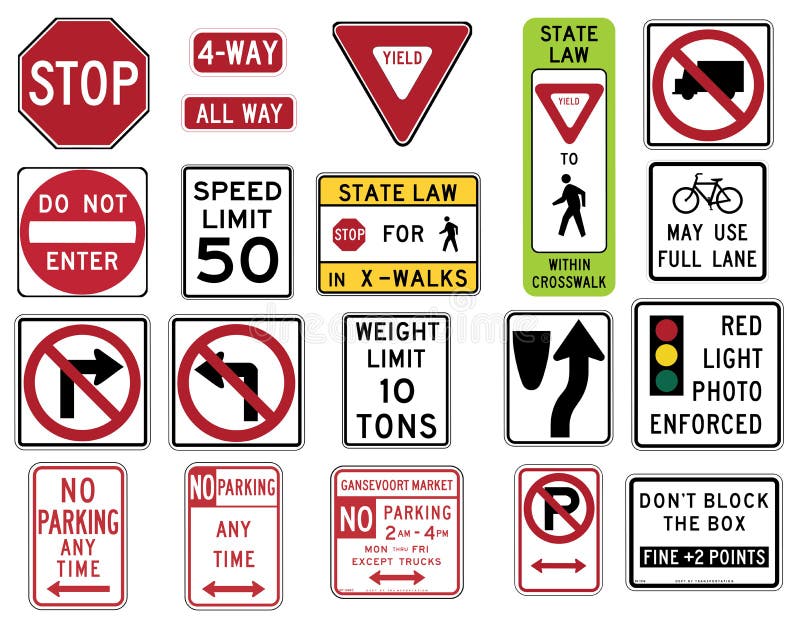
Free with trial Vector Illustration collection of the select Traffic Signs in the United States, isolated on white background. You can find other road signs in my portfolio. EPS file available. In the United States, road signs are, for the most part, standardized by federal regulations, most notably in the Manual on Uniform Traffic Control Devices (MUTCD) and its companion volume the Standard Highway Signs (SHS). There currently are no plans for adopting the Vienna Convention on Road Signs and Signals standards. Twenty-three states along with the District of Columbia and Puerto Rico use the manual without any alterations, 20 states have adopted it in conjunction with a supplemental volume, and seven states have a state version in substantial conformance to the MUTCD. There are also localized versions that are used in large cities such as New York City which use a naming system compatible with the MUTCD and/or state supplement. The MUTCD and SHS establish seven general categories of signs for road and highway use. Included illustrations are select examples of the following MUTCD categories: -- R1 Series STOP and YIELD -- R2 Series Speed Limit -- R3 Series Lane Usage and Turns (Left and Right Turn) -- R4 Regulation of Movement -- R5 Series: Exclusionary -- R7 Series: Parking. Large control vectors Traffic Signs in the United States - Regulatory Series. Vector Illustration collection of the select Traffic Signs in the United States, isolated on white. Vector Illustration collection of the select Traffic Signs in the United States, isolated on white background. You can find other road signs in my portfolio. EPS file available. In the United States, road signs are, for the most part, standardized by federal regulations, most notably in the Manual on Uniform Traffic Control Devices (MUTCD) and its companion volume the Standard Highway Signs (SHS). There currently are no plans for adopting the Vienna Convention on Road Signs and Signals standards. Twenty-three states along with the District of Columbia and Puerto Rico use the manual without any alterations, 20 states have adopted it in conjunction with a supplemental volume, and seven states have a state version in substantial conformance to the MUTCD. There are also localized versions that are used in large cities such as New York City which use a naming system compatible with the MUTCD and/or state supplement. The MUTCD and SHS establish seven general categories of signs for road and highway use. Included illustrations are select examples of the following MUTCD categories: -- R1 Series STOP and YIELD -- R2 Series Speed Limit -- R3 Series Lane Usage and Turns (Left and Right Turn) -- R4 Regulation of Movement -- R5 Series: Exclusionary -- R7 Series: Parking
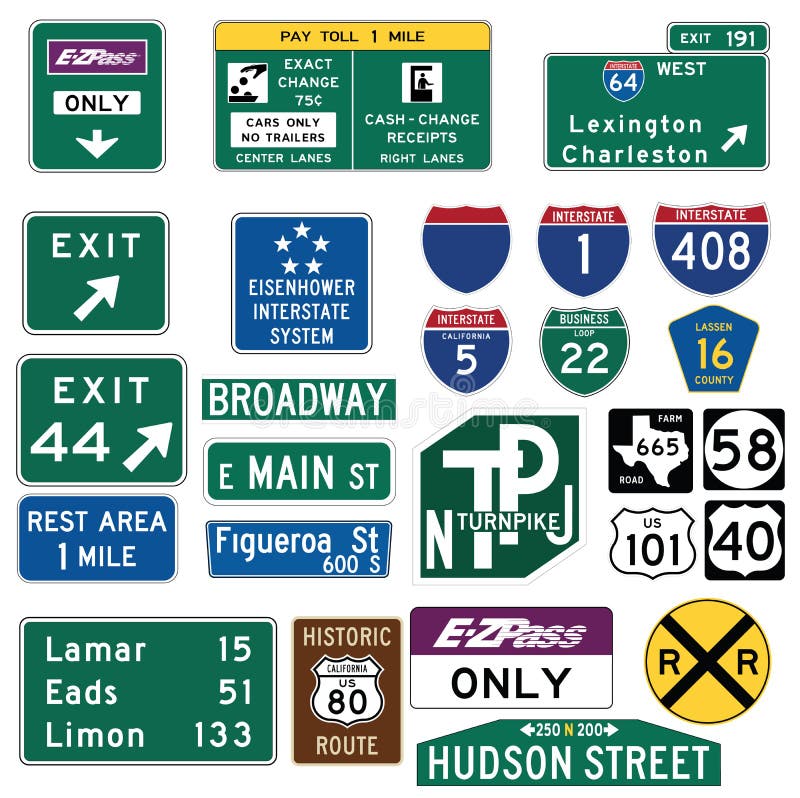
Free with trial Vector Illustration collection of the select Traffic Signs in the United States, isolated on white background. You can find other road signs in my portfolio. EPS file available. Guide signs are essential to direct road users along streets and highways, to inform them of intersecting routes, rnto direct them to cities, towns, villages, or other important destinations, to identify nearby rivers and streams, parks, forests, and historical sites, and generally to give such information as will help them along their way in the most simple, direct manner possible. rnrnIn the United States, road signs are, for the most part, standardized by federal regulations, most notably in the Manual on Uniform Traffic Control Devices (MUTCD) and its companion volume the Standard Highway Signs (SHS). There currently are no plans for adopting the Vienna Convention on Road Signs and Signals standards. Twenty-three states along with the District of Columbia and Puerto Rico use the manual without any alterations, 20 states have adopted it in conjunction with a supplemental volume, and seven states have a state version in substantial conformance to the MUTCD. There are also localized versions that are used in large cities such as New York City which use a naming system compatible with the MUTCD and/or state supplement. The MUTCD and SHS establish seven general categories of signs for road and highway use. rnrnIncluded illustrations are select examples of the MUTCD Guide Signs categories. rn. Large control vectors Traffic Guide Signs in the United States. Vector Illustration collection of the select Traffic Signs in the United States, isolated on white background. You can. Vector Illustration collection of the select Traffic Signs in the United States, isolated on white background. You can find other road signs in my portfolio. EPS file available. Guide signs are essential to direct road users along streets and highways, to inform them of intersecting routes, rnto direct them to cities, towns, villages, or other important destinations, to identify nearby rivers and streams, parks, forests, and historical sites, and generally to give such information as will help them along their way in the most simple, direct manner possible.rnrnIn the United States, road signs are, for the most part, standardized by federal regulations, most notably in the Manual on Uniform Traffic Control Devices (MUTCD) and its companion volume the Standard Highway Signs (SHS). There currently are no plans for adopting the Vienna Convention on Road Signs and Signals standards. Twenty-three states along with the District of Columbia and Puerto Rico use the manual without any alterations, 20 states have adopted it in conjunction with a supplemental volume, and seven states have a state version in substantial conformance to the MUTCD. There are also localized versions that are used in large cities such as New York City which use a naming system compatible with the MUTCD and/or state supplement. The MUTCD and SHS establish seven general categories of signs for road and highway use.rnrnIncluded illustrations are select examples of the MUTCD Guide Signs categories.rn
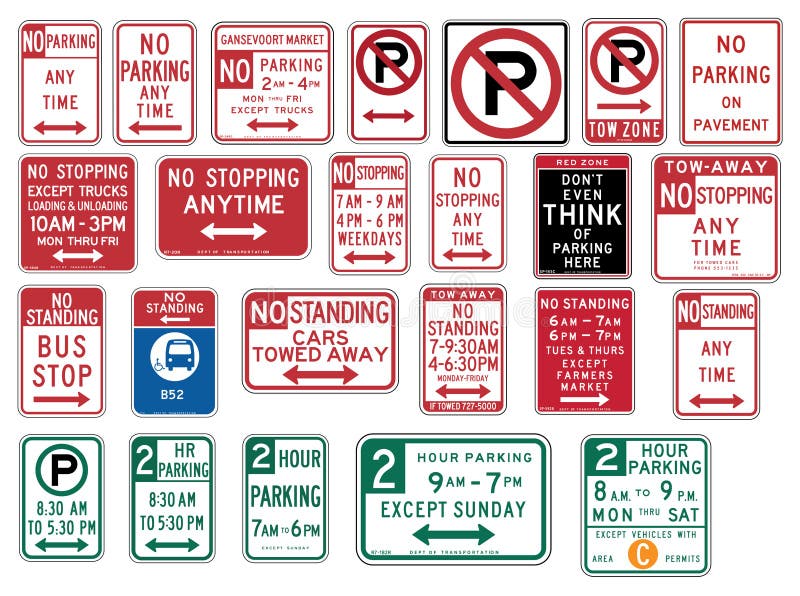
Free with trial Vector Illustration collection of the select Traffic Signs in the United States, isolated on white background. You can find other road signs in my portfolio. EPS file available. rnrnIn the United States, road signs are, for the most part, standardized by federal regulations, most notably in the Manual on Uniform Traffic Control Devices (MUTCD) and its companion volume the Standard Highway Signs (SHS). There currently are no plans for adopting the Vienna Convention on Road Signs and Signals standards. rnTwenty-three states along with the District of Columbia and Puerto Rico use the manual without any alterations, 20 states have adopted it in conjunction with a supplemental volume, and seven states have a state version in substantial conformance to the MUTCD. There are also localized versions that are used in large cities such as New York City which use a naming system compatible with the MUTCD and/or state supplement. The MUTCD and SHS establish seven general categories of signs for road and highway use. rnrnIncluded illustrations are select examples of the following MUTCD categories:rn-- R7 Series: Parkingrnrn. Large control vectors Traffic Signs in the United States - No Parking. Vector Illustration collection of the select Traffic Signs in the United States, isolated on white background. Vector Illustration collection of the select Traffic Signs in the United States, isolated on white background. You can find other road signs in my portfolio. EPS file available.rnrnIn the United States, road signs are, for the most part, standardized by federal regulations, most notably in the Manual on Uniform Traffic Control Devices (MUTCD) and its companion volume the Standard Highway Signs (SHS). There currently are no plans for adopting the Vienna Convention on Road Signs and Signals standards.rnTwenty-three states along with the District of Columbia and Puerto Rico use the manual without any alterations, 20 states have adopted it in conjunction with a supplemental volume, and seven states have a state version in substantial conformance to the MUTCD. There are also localized versions that are used in large cities such as New York City which use a naming system compatible with the MUTCD and/or state supplement. The MUTCD and SHS establish seven general categories of signs for road and highway use.rnrnIncluded illustrations are select examples of the following MUTCD categories:rn-- R7 Series: Parkingrnrn
Free with trial CCTV security camera. Large collection of black and white surveillance devices. Vector 3d illustration isolated on white background. Large control vectors CCTV security camera. Large collection of black and white surveillance devices. Vector 3d illustration isolated on white background
Free with trial Fat man. Very overweight man sitting on the couch holding a remote in hand, beer, pizza and other food over the floor. Couch potato cartoon. Vector illustration. Large control vectors Fat man. Very overweight man sitting on the couch holding a remote in hand, beer, pizza and other food over the floor. Couch potato cartoon. Vector illustration
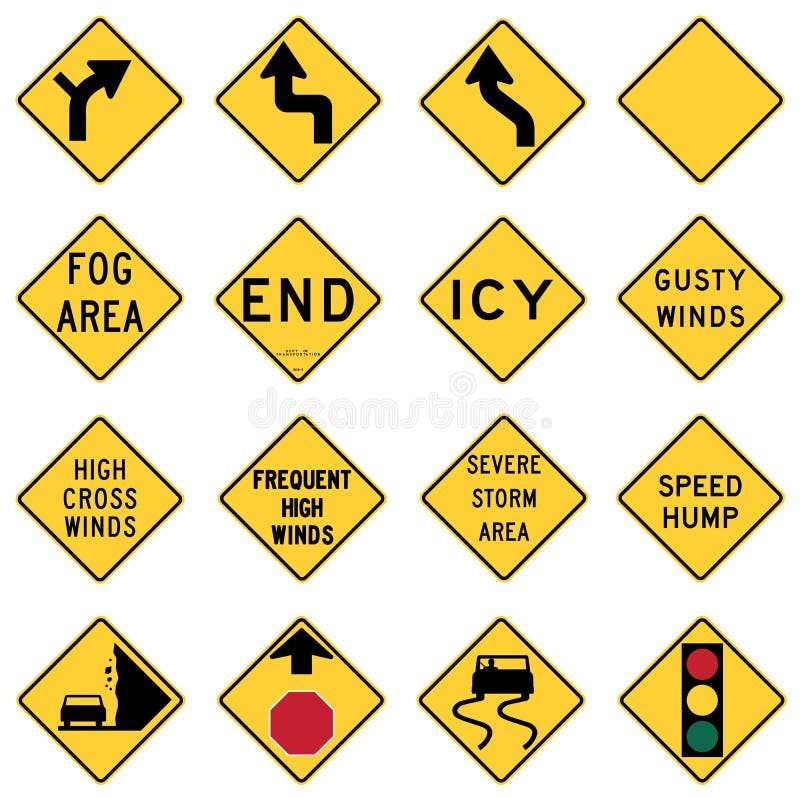
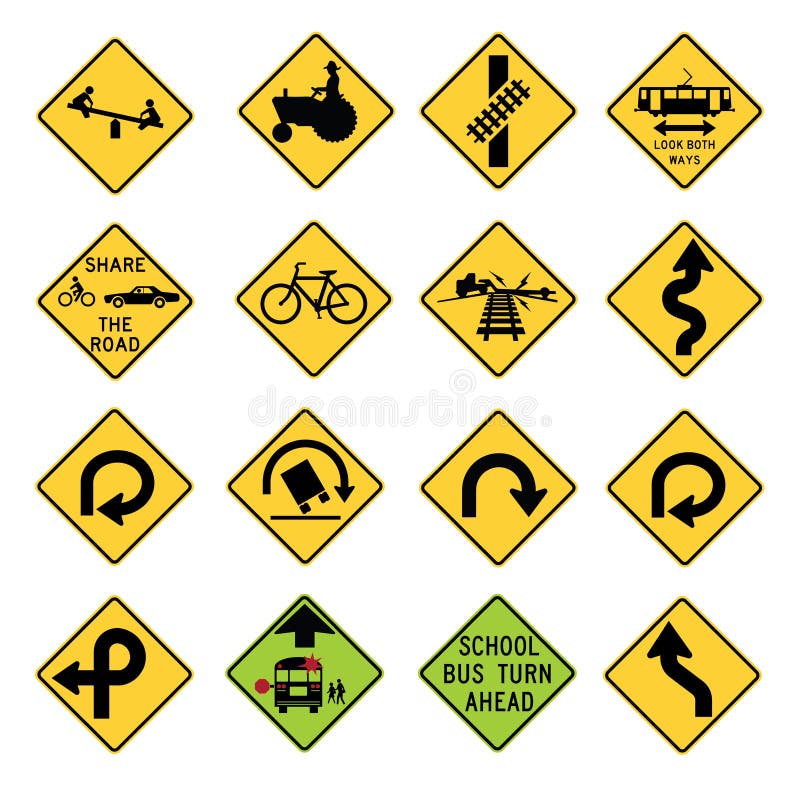
Free with trial Vector Illustration collection of the select Traffic Signs in the United States, isolated on white background. You can find other road signs in my portfolio. EPS file available. Warning signs are found in the W series of the national MUTCD. They highlight existing conditions, such as a curve, school, dead end street, or traffic signal. They can also warn possible danger such as bumps, bicycles, low flying aircraft or emergency vehicles. These signs are either yellow or fluorescent yellow in color and with the exception of a few signs are usually diamond shaped and sometimes have square or rectangular smaller signs or plaques associated with them. Most W series signs can also be found in with orange backgrounds, for temporary use in situations such as construction zones. Some of the temporary use signs are only for use in temporary situations. In the United States, road signs are, for the most part, standardized by federal regulations, most notably in the Manual on Uniform Traffic Control Devices (MUTCD) and its companion volume the Standard Highway Signs (SHS). There currently are no plans for adopting the Vienna Convention on Road Signs and Signals standards. Twenty-three states along with the District of Columbia and Puerto Rico use the manual without any alterations, 20 states have adopted it in conjunction with a supplemental volume, and seven states have a state version in substantial conformance to the MUTCD. There are also localized versions that are used in large cities such as New York City which use a naming system compatible with the MUTCD and/or state supplement. The MUTCD and SHS establish seven general categories of signs for road and highway use. Included illustrations are select examples of the MUTCD Warning Signs categories. Large control vectors Traffic Warning Signs in the United States. Vector Illustration collection of the select Traffic Signs in the United States, isolated on white background. You. Vector Illustration collection of the select Traffic Signs in the United States, isolated on white background. You can find other road signs in my portfolio. EPS file available. Warning signs are found in the W series of the national MUTCD. They highlight existing conditions, such as a curve, school, dead end street, or traffic signal. They can also warn possible danger such as bumps, bicycles, low flying aircraft or emergency vehicles. These signs are either yellow or fluorescent yellow in color and with the exception of a few signs are usually diamond shaped and sometimes have square or rectangular smaller signs or plaques associated with them. Most W series signs can also be found in with orange backgrounds, for temporary use in situations such as construction zones. Some of the temporary use signs are only for use in temporary situations. In the United States, road signs are, for the most part, standardized by federal regulations, most notably in the Manual on Uniform Traffic Control Devices (MUTCD) and its companion volume the Standard Highway Signs (SHS). There currently are no plans for adopting the Vienna Convention on Road Signs and Signals standards. Twenty-three states along with the District of Columbia and Puerto Rico use the manual without any alterations, 20 states have adopted it in conjunction with a supplemental volume, and seven states have a state version in substantial conformance to the MUTCD. There are also localized versions that are used in large cities such as New York City which use a naming system compatible with the MUTCD and/or state supplement. The MUTCD and SHS establish seven general categories of signs for road and highway use. Included illustrations are select examples of the MUTCD Warning Signs categories.
Free with trial Vector Illustration collection of the select Traffic Signs in the United States, isolated on white background. You can find other road signs in my portfolio. EPS file available. Warning signs are found in the W series of the national MUTCD. They highlight existing conditions, such as a curve, school, dead end street, or traffic signal. They can also warn possible danger such as bumps, bicycles, low flying aircraft or emergency vehicles. These signs are either yellow or fluorescent yellow in color and with the exception of a few signs are usually diamond shaped and sometimes have square or rectangular smaller signs or plaques associated with them. Most W series signs can also be found in with orange backgrounds, for temporary use in situations such as construction zones. Some of the temporary use signs are only for use in temporary situations. In the United States, road signs are, for the most part, standardized by federal regulations, most notably in the Manual on Uniform Traffic Control Devices (MUTCD) and its companion volume the Standard Highway Signs (SHS). There currently are no plans for adopting the Vienna Convention on Road Signs and Signals standards. Twenty-three states along with the District of Columbia and Puerto Rico use the manual without any alterations, 20 states have adopted it in conjunction with a supplemental volume, and seven states have a state version in substantial conformance to the MUTCD. There are also localized versions that are used in large cities such as New York City which use a naming system compatible with the MUTCD and/or state supplement. The MUTCD and SHS establish seven general categories of signs for road and highway use. Included illustrations are select examples of the MUTCD Warning Signs categories. Large control vectors Traffic Warning Signs in the United States. Vector Illustration collection of the select Traffic Signs in the United States, isolated on white background. You. Vector Illustration collection of the select Traffic Signs in the United States, isolated on white background. You can find other road signs in my portfolio. EPS file available. Warning signs are found in the W series of the national MUTCD. They highlight existing conditions, such as a curve, school, dead end street, or traffic signal. They can also warn possible danger such as bumps, bicycles, low flying aircraft or emergency vehicles. These signs are either yellow or fluorescent yellow in color and with the exception of a few signs are usually diamond shaped and sometimes have square or rectangular smaller signs or plaques associated with them. Most W series signs can also be found in with orange backgrounds, for temporary use in situations such as construction zones. Some of the temporary use signs are only for use in temporary situations. In the United States, road signs are, for the most part, standardized by federal regulations, most notably in the Manual on Uniform Traffic Control Devices (MUTCD) and its companion volume the Standard Highway Signs (SHS). There currently are no plans for adopting the Vienna Convention on Road Signs and Signals standards. Twenty-three states along with the District of Columbia and Puerto Rico use the manual without any alterations, 20 states have adopted it in conjunction with a supplemental volume, and seven states have a state version in substantial conformance to the MUTCD. There are also localized versions that are used in large cities such as New York City which use a naming system compatible with the MUTCD and/or state supplement. The MUTCD and SHS establish seven general categories of signs for road and highway use. Included illustrations are select examples of the MUTCD Warning Signs categories.
Free with trial Gamer. T-shirt or poster print design. Large control vectors Gamer. T-shirt or poster print design
Free with trial Cognition Change. Large eye watches cognition change. Large control illustrations Cognition Change. Large eye watches cognition change
Free with trial Help. Large blurred figure carries three small figures. Concept of help and power. Large control illustrations Help. Large blurred figure carries three small figures. Concept of help and power
Free with trial Large group of people in the symbol shape of a gaming controller on a white background. Large control illustrations People who are gamers. Large group of people in the symbol shape of a gaming controller on a white background. Large group of people in the symbol shape of a gaming controller on a white background.
Free with trial Large Space Rocket Saturn-5. Illustration Over Black Space. Large control vectors Large Space Rocket Saturn-5. Illustration Over Black Space
Free with trial Large Space Rocket Saturn-5. Illustration Over White. Large control vectors Large Space Rocket Saturn-5. Illustration Over White
Free with trial Large group of people forming the United States of America. Immigration, travel, visiting, refugee, integration concept. Large control illustrations People coming to America concept. Large group of people forming the United States of America. Immigration, travel, visiting, refugee, integration concept. Large group of people forming the United States of America. Immigration, travel, visiting, refugee, integration concept.
Free with trial Radiation hazard symbol sign of radhaz threat alert icon, isolated black yellow triangle signage label macro, large detailed. Closeup. Large control illustrations Radiation hazard symbol sign of radhaz threat alert icon, isolated black yellow triangle signage label macro, large detailed. Closeup
Free with trial Large collection of thin universal web icon set. 144 thin universal web icon set for your flat design isolated on white. Large control vectors Large collection of thin universal web icon set. 144 thin universal web icon set for your flat design isolated on white
Free with trial A computer generated word cloud concept illustration depicting the concept of Project management, with relevant key words related to the subject decorating the colorful border, including words about the workflow, objectives and process to completion. Simple and clean design with subtle colours. Large colorful words on light color background with project management in large light font texts. Large control illustrations Project management concept. A computer generated word cloud concept illustration depicting the concept of Project management, with relevant key words related to. A computer generated word cloud concept illustration depicting the concept of Project management, with relevant key words related to the subject decorating the colorful border, including words about the workflow, objectives and process to completion. Simple and clean design with subtle colours. Large colorful words on light color background with project management in large light font texts.
Free with trial Security camera. On white background. Large control illustrations Security camera. On white background
Free with trial Change - Start Here Button. Hands Offering A Large Red Button For Changing Your Life. Large control illustrations Change - Start Here Button. Hands Offering A Large Red Button For Changing Your Life
Free with trial Red tape. Cutting through the red tape and getting rid of time-consuming bureaucracy. Large control illustrations Red tape. Cutting through the red tape and getting rid of time-consuming bureaucracy
Free with trial Overweight. 8 figures of thick women are on the scales. Large control vectors Overweight. 8 figures of thick women are on the scales
Free with trial What's On TV?. Woman sits in front of the tv with remote in hand. Large control vectors What's On TV?. Woman sits in front of the tv with remote in hand
Free with trial Computer security. Isolated illustration of a computer secured with a large chain and padlock. Large control illustrations Computer security. Isolated illustration of a computer secured with a large chain and padlock
Free with trial New Life Red Button. Hands Offering A Large Button For Starting A New Life. Large control illustrations New Life Red Button. Hands Offering A Large Button For Starting A New Life
Free with trial Illustration of a teenage girl sitting down at a desk surfing the internet. She is blissfully un aware of the evils of social networking represented by a large group of skeletal predators watching her in the background. Large control vectors Social Network Danger. Illustration of a teenage girl sitting down at a desk surfing the internet. She is blissfully un aware of the evils of social networking. Illustration of a teenage girl sitting down at a desk surfing the internet. She is blissfully un aware of the evils of social networking represented by a large group of skeletal predators watching her in the background
Free with trial Cartoon stick man drawing conceptual illustration of businessman running from large clock. Business concept of rushing for deadline. Large control vectors Conceptual Cartoon of Businessman Rushing for Deadline. Cartoon stick man drawing conceptual illustration of businessman running from large clock. Business. Cartoon stick man drawing conceptual illustration of businessman running from large clock. Business concept of rushing for deadline.
Free with trial Scale and body weight diagram. Large control vectors Body weight supervision. Scale and body weight diagram. Scale and body weight diagram.
Free with trial Monitors with office armchair. Set of monitors with static colourful and bright images and office armchair. Large control illustrations Monitors with office armchair. Set of monitors with static colourful and bright images and office armchair
Free with trial 3D rendered image of a team communicating through a manager. Large control illustrations 3D Manager and Team. 3D rendered image of a team communicating through a manager. 3D rendered image of a team communicating through a manager.
Free with trial Aircraft. Realistic illustration aircraft is isolated on white background. Vector. Large control vectors Aircraft. Realistic illustration aircraft is isolated on white background. Vector
Free with trial Crowd of people gathered in an arrow shape, leadership, choice and direction concept. Large control vectors Crowd of people gathered in an arrow shape. Leadership, choice and direction concept
Free with trial The human brain has the same general structure as the brains of other mammals, but has a more developed cerebral cortex than any other. Large animals such as whales and elephants have larger brains in absolute terms, but when measured using the encephalization quotient, which compensates for body size, the human brain is almost twice as large as the brain of the bottlenose dolphin, and three times as large as the brain of a chimpanzee. Much of the expansion comes from the cerebral cortex, especially the frontal lobes, which are associated with executive functions such as self-control, planning, reasoning, and abstract thought. The portion of the cerebral cortex devoted to vision, the visual cortex, is also greatly enlarged in humans. Large control illustrations Human Brain. The human brain has the same general structure as the brains of other mammals, but has a more developed cerebral cortex than any other. Large. The human brain has the same general structure as the brains of other mammals, but has a more developed cerebral cortex than any other. Large animals such as whales and elephants have larger brains in absolute terms, but when measured using the encephalization quotient, which compensates for body size, the human brain is almost twice as large as the brain of the bottlenose dolphin, and three times as large as the brain of a chimpanzee. Much of the expansion comes from the cerebral cortex, especially the frontal lobes, which are associated with executive functions such as self-control, planning, reasoning, and abstract thought. The portion of the cerebral cortex devoted to vision, the visual cortex, is also greatly enlarged in humans.
Free with trial Illustration vector of flight deck or cockpit. Illustration vector of flight deck or cabin or cockpit in an airplane or airbus. Large control vectors Illustration vector of flight deck or cockpit. Illustration vector of flight deck or cabin or cockpit in an airplane or airbus
Free with trial Couch potato man. Couch potato slob overweight man sitting on the sofa, eating pizza slice and popcorn while watching TV. Large control vectors Couch potato man. Couch potato slob overweight man sitting on the sofa, eating pizza slice and popcorn while watching TV
Free with trial One page web design template with thin line icons of cargo freight shipping by water, sea transport delivery, export logistics control. Flat design graphic hero image concept, website elements layout. Large control vectors Water logistics flat line web graphics. One page web design template with thin line icons of cargo freight shipping by water, sea transport delivery, export. One page web design template with thin line icons of cargo freight shipping by water, sea transport delivery, export logistics control. Flat design graphic hero image concept, website elements layout.
Free with trial A large group of people in the form of checkmark. Vector illustration. Large control vectors Group people form checkmark. A large group of people in the form of checkmark . Vector illustration. A large group of people in the form of checkmark . Vector illustration.
Free with trial Women astronauts in the cabin of a spaceship and Burger. Fast food. Vintage comics pop art retro color illustration. Large control vectors Women astronauts in the cabin of a spaceship and Burger. Fast food. Vintage comics pop art retro color illustration
Free with trial Central heating attached to wall. With closed windows. Large control illustrations Central heating attached to wall. With closed windows
Free with trial Central heating radiator. See my other works in portfolio. Large control illustrations Central heating radiator. See my other works in portfolio
Free with trial Vector truck. Black truck silhouette, vector illustration. Large control vectors Vector truck. Black truck silhouette, vector illustration
Free with trial Realisic illustration airplane. Realisic illustration of airplane isolated. Vector. Large control vectors Realisic illustration airplane. Realisic illustration of airplane isolated. Vector
Free with trial Fat woman cartoon very worried with her weight. Illustration of Fat woman cartoon very worried with her weight. Large control vectors Fat woman cartoon very worried with her weight. Illustration of Fat woman cartoon very worried with her weight
Free with trial Vector illustration of a woman before and after weight loss. Female body silhouette. Successful diet and sport concept. Slim and fat girls. Large control vectors Vector illustration of a woman before and after weight loss. Female body silhouette. Slim and fat girls. Vector illustration of a woman before and after weight. Vector illustration of a woman before and after weight loss. Female body silhouette. Successful diet and sport concept. Slim and fat girls.
Free with trial Hand drawn card with big car and lettering. Words Be Creative. Watercolor multicolor illustration. Active crazy sport. Transport. Perfect for blogs, lettering, pattern, invitation, t-shirt, print. Large control illustrations Hand drawn card with big car and lettering. Words Be Creative . Watercolor multicolor illustration. Active crazy sport. Transport. Perfect for blogs, lettering
Free with trial Magnifier Isolated With White Background. With Gradient Mesh, Vector Illustration. Large control vectors Magnifier Isolated With White Background. With Gradient Mesh, Vector Illustration
Free with trial Мan security guard of nightclub. Illustration, man security guard of nightclub, format EPS 10. Large control vectors Мan security guard of nightclub. Illustration, man security guard of nightclub, format EPS 10
Free with trial Set of vector logos insurance. Large set of vector logos insurance. Large control vectors Set of vector logos insurance. Large set of vector logos insurance
Free with trial Set of vector logos for natural products. Large control vectors Set of vector logos for natural products. Large set of vector logos for natural products
Free with trial Illustration of Businessman behind the word time holds a large hourglass. Time control concept. isolated. Large control illustrations Businessman behind the word time holds a large hourglass. Time control concept. isolated. Illustration of Businessman behind the word time holds a large. Illustration of Businessman behind the word time holds a large hourglass. Time control concept. isolated
Free with trial Large set of line icons for inspections and quality control with check lists, magnifying glass, inspectors, and microscope, vector illustration for design elements. Large control vectors Large set of line icons for inspections and quality control. With check lists, magnifying glass, inspectors, and microscope, vector illustration for design
Free with trial Illustration of group of students protesting with signs and banners. Large group of young students demonstrating againts gun control. Large control vectors Illustration of group of students protesting with signs and banners. Large group of young students demonstrating againts gun control
Free with trial Types of bariatric surgery and stomach reduction control outline diagram. Labeled educational scheme with digestive gastric operation methods vector illustration. Medical procedure process examples. Large control vectors Types of bariatric surgery and stomach reduction control outline diagram. Labeled educational scheme with digestive gastric operation methods vector
Free with trial Large new TV or computer monitor illustration with wide empty screen, black frame and stand. Hand painted water color sketchy monochrome drawing on white, cutout clipart element for stylish design. Large control illustrations Large new TV or computer monitor illustration. Large new TV or computer monitor illustration with wide empty screen, black frame and stand. Hand painted water. Large new TV or computer monitor illustration with wide empty screen, black frame and stand. Hand painted water color sketchy monochrome drawing on white, cutout clipart element for stylish design.
Free with trial A box of medicines. A large white box with a set of medicines. Flat design, illustration,. Large control illustrations A box of medicines. A large white box with a set of medicines. Flat design, illustration
Free with trial Workers With Plotter Set Vector. Woman, Man. Prints Beautiful Picture, Banner. Print Service. Large Format Multifunction Printer. Polygraphy. Full Color, Laser Printer Printshop Illustration. Large control vectors Workers With Plotter Set Vector. Woman, Man. Prints Beautiful Picture, Banner. Print Service. Large Format Multifunction. Printer. Polygraphy. Full Color, Laser. Workers With Plotter Set Vector. Woman, Man. Prints Beautiful Picture, Banner. Print Service. Large Format Multifunction Printer. Polygraphy. Full Color, Laser Printer Printshop Illustration
Free with trial Plotter, Printer Vector. Large Format Multifunction Printer. Polygraphy, Printshop Service. Isolated Cartoon Illustration. Large control vectors Plotter, Printer Vector. Large Format Multifunction Printer. Polygraphy, Printshop Service. Isolated Flat Cartoon. Plotter, Printer Vector. Large Format. Plotter, Printer Vector. Large Format Multifunction Printer. Polygraphy, Printshop Service. Isolated Cartoon Illustration
Free with trial Empty winter room. With large central heating device. Large control illustrations Empty winter room. With large central heating device
Free with trial Empty Video Wall. Illustration featuring a control room equipped with an empty video wall of flat tv screens. Large control illustrations Empty Video Wall. Illustration featuring a control room equipped with an empty video wall of flat tv screens
Free with trial Birth control. A mother with many children is angry with the stork who wants to bring another baby. Large control illustrations Birth control. A mother with many children is angry with the stork who wants to bring another baby
Free with trial Dark spaceship interior with large window view 3D rendering. Large control illustrations Dark spaceship interior with large window view 3D rendering. Dark spaceship interior with large window view on space 3D rendering
Free with trial White spaceship interior with large window view 3D rendering. Large control illustrations White spaceship interior with large window view 3D rendering. White spaceship interior with large window view on space 3D rendering
Free with trial White spaceship interior with large window view 3D rendering. Large control illustrations White spaceship interior with large window view 3D rendering. White spaceship interior with large window view on space 3D rendering
Free with trial Forbidden and freedom, businessman breaking out the large birdcage - Business concept vector, modern flat Vector illustration. Large control vectors Forbidden and freedom, businessman breaking out the large birdcage - Business concept vector. Modern flat Vector illustration
Free with trial CCTV camera. Large collection of white and black security surveillance system. Wall and ceiling mounted. Vector 3d illustration isolated on white background. Large control vectors CCTV camera. Large collection of white and black security surveillance system. Wall and ceiling mounted. Vector 3d illustration isolated on white background
Free with trial Security camera. On white background. Large control illustrations Security camera. On white background
Free with trial Illustration of a large dog silhouette with shadow. Large control vectors Big dog. Illustration of a large dog silhouette with shadow. Illustration of a large dog silhouette with shadow.
Free with trial Blue Explosion. Energy explosion behind cube grid. Large control illustrations Blue Explosion. Energy explosion behind cube grid
Free with trial Magnifier. Magnifying glass on a white background. Large control vectors Magnifier. Magnifying glass on a white background
Free with trial Direction choices choosing the right strategic path for business and life with a large group of yellow traffic signs with confused arrows tangled roads and highways in a chaotic path. Large control illustrations Direction choices. Choosing the right strategic path for business and life with a large group of yellow traffic signs with confused arrows tangled roads and. Direction choices choosing the right strategic path for business and life with a large group of yellow traffic signs with confused arrows tangled roads and highways in a chaotic path.
Free with trial A set of multimedia icons for web development and representation. Large control vectors Multimedia Web Icons. A set of multimedia icons for web development and representation. A set of multimedia icons for web development and representation.
Free with trial Large ammount of different media-buttons. Designers who are working on any kind of audio/video design projects will find this set usefull. Acid green glow on roll over. Large control illustrations Big media-buttons set. Large ammount of different media-buttons. Designers who are working on any kind of audio/video design projects will find this set usefull. Large ammount of different media-buttons. Designers who are working on any kind of audio/video design projects will find this set usefull. Acid green glow on roll over.
Free with trial Large ammount of different media-buttons. Designers who are working on any kind of audio/video design projects will find this set usefull. Orange glow on roll over. Large control illustrations Big media-buttons set. Large ammount of different media-buttons. Designers who are working on any kind of audio/video design projects will find this set usefull. Large ammount of different media-buttons. Designers who are working on any kind of audio/video design projects will find this set usefull. Orange glow on roll over.
Free with trial Powerful valve. Red valve isolated on the white background. Large control illustrations Powerful valve. Red valve isolated on the white background
Free with trial Weight loss pants. Image of a man showing how much he got his weight lost by pulling his pants. Large control vectors Weight loss pants. Image of a man showing how much he got his weight lost by pulling his pants
Free with trial Radiator in empty room. Central heating radiator conceptual of increasing costs of energy. Large control illustrations Radiator in empty room. Central heating radiator conceptual of increasing costs of energy
Free with trial Military Drone Flight at Night. Large Moon and The Drone. Large control illustrations Military Drone Flight at Night. Large Moon and The Drone
Free with trial Plasma on white. Plasma lcd tv with remote control on white background, illustration. Large control vectors Plasma on white. Plasma lcd tv with remote control on white background, illustration
Free with trial Vector illustration of a cartoon businessman standing in front of a large touch screen displaying a social network with personal information. Large control vectors Businessman, social network, personal information. Vector illustration of a cartoon businessman standing in front of a large touch screen displaying a social. Vector illustration of a cartoon businessman standing in front of a large touch screen displaying a social network with personal information.
Free with trial Global Communications. Digital Internet and Projection Screen. Large control illustrations Global Communications. Digital Internet and Projection Screen
Free with trial Vector illustration of a scared cartoon businessman running away from huge foot. Large control vectors Businessman running away from huge foot. Vector illustration of a scared cartoon businessman running away from huge foot. Vector illustration of a scared cartoon businessman running away from huge foot.
 Sign in