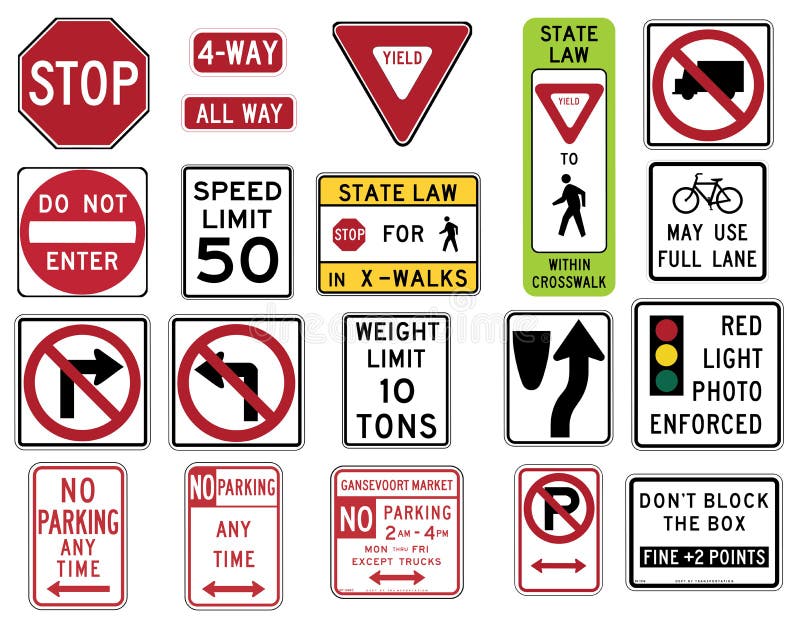
Free with trial Vector Illustration collection of the select Traffic Signs in the United States, isolated on white background. You can find other road signs in my portfolio. EPS file available. In the United States, road signs are, for the most part, standardized by federal regulations, most notably in the Manual on Uniform Traffic Control Devices (MUTCD) and its companion volume the Standard Highway Signs (SHS). There currently are no plans for adopting the Vienna Convention on Road Signs and Signals standards. Twenty-three states along with the District of Columbia and Puerto Rico use the manual without any alterations, 20 states have adopted it in conjunction with a supplemental volume, and seven states have a state version in substantial conformance to the MUTCD. There are also localized versions that are used in large cities such as New York City which use a naming system compatible with the MUTCD and/or state supplement. The MUTCD and SHS establish seven general categories of signs for road and highway use. Included illustrations are select examples of the following MUTCD categories: -- R1 Series STOP and YIELD -- R2 Series Speed Limit -- R3 Series Lane Usage and Turns (Left and Right Turn) -- R4 Regulation of Movement -- R5 Series: Exclusionary -- R7 Series: Parking. Adopted vectors Traffic Signs in the United States - Regulatory Series. Vector Illustration collection of the select Traffic Signs in the United States, isolated on white. Vector Illustration collection of the select Traffic Signs in the United States, isolated on white background. You can find other road signs in my portfolio. EPS file available. In the United States, road signs are, for the most part, standardized by federal regulations, most notably in the Manual on Uniform Traffic Control Devices (MUTCD) and its companion volume the Standard Highway Signs (SHS). There currently are no plans for adopting the Vienna Convention on Road Signs and Signals standards. Twenty-three states along with the District of Columbia and Puerto Rico use the manual without any alterations, 20 states have adopted it in conjunction with a supplemental volume, and seven states have a state version in substantial conformance to the MUTCD. There are also localized versions that are used in large cities such as New York City which use a naming system compatible with the MUTCD and/or state supplement. The MUTCD and SHS establish seven general categories of signs for road and highway use. Included illustrations are select examples of the following MUTCD categories: -- R1 Series STOP and YIELD -- R2 Series Speed Limit -- R3 Series Lane Usage and Turns (Left and Right Turn) -- R4 Regulation of Movement -- R5 Series: Exclusionary -- R7 Series: Parking
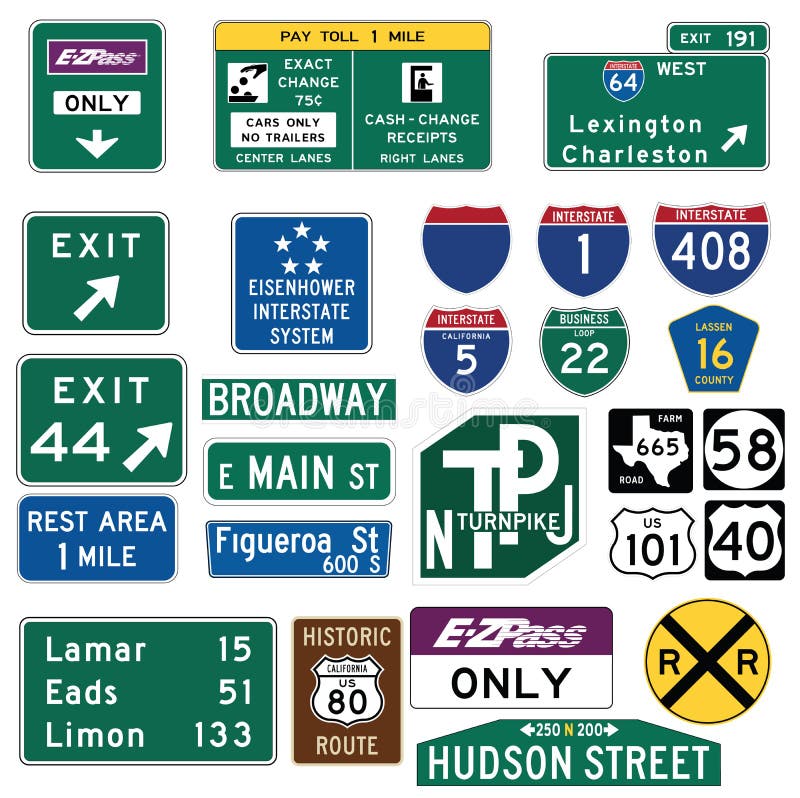
Free with trial Vector Illustration collection of the select Traffic Signs in the United States, isolated on white background. You can find other road signs in my portfolio. EPS file available. Guide signs are essential to direct road users along streets and highways, to inform them of intersecting routes, rnto direct them to cities, towns, villages, or other important destinations, to identify nearby rivers and streams, parks, forests, and historical sites, and generally to give such information as will help them along their way in the most simple, direct manner possible. rnrnIn the United States, road signs are, for the most part, standardized by federal regulations, most notably in the Manual on Uniform Traffic Control Devices (MUTCD) and its companion volume the Standard Highway Signs (SHS). There currently are no plans for adopting the Vienna Convention on Road Signs and Signals standards. Twenty-three states along with the District of Columbia and Puerto Rico use the manual without any alterations, 20 states have adopted it in conjunction with a supplemental volume, and seven states have a state version in substantial conformance to the MUTCD. There are also localized versions that are used in large cities such as New York City which use a naming system compatible with the MUTCD and/or state supplement. The MUTCD and SHS establish seven general categories of signs for road and highway use. rnrnIncluded illustrations are select examples of the MUTCD Guide Signs categories. rn. Adopted vectors Traffic Guide Signs in the United States. Vector Illustration collection of the select Traffic Signs in the United States, isolated on white background. You can. Vector Illustration collection of the select Traffic Signs in the United States, isolated on white background. You can find other road signs in my portfolio. EPS file available. Guide signs are essential to direct road users along streets and highways, to inform them of intersecting routes, rnto direct them to cities, towns, villages, or other important destinations, to identify nearby rivers and streams, parks, forests, and historical sites, and generally to give such information as will help them along their way in the most simple, direct manner possible.rnrnIn the United States, road signs are, for the most part, standardized by federal regulations, most notably in the Manual on Uniform Traffic Control Devices (MUTCD) and its companion volume the Standard Highway Signs (SHS). There currently are no plans for adopting the Vienna Convention on Road Signs and Signals standards. Twenty-three states along with the District of Columbia and Puerto Rico use the manual without any alterations, 20 states have adopted it in conjunction with a supplemental volume, and seven states have a state version in substantial conformance to the MUTCD. There are also localized versions that are used in large cities such as New York City which use a naming system compatible with the MUTCD and/or state supplement. The MUTCD and SHS establish seven general categories of signs for road and highway use.rnrnIncluded illustrations are select examples of the MUTCD Guide Signs categories.rn
Free with trial Illustration of successful family design isolated on white background. Adopted vectors Successful family. Illustration of successful family design isolated on white background. Illustration of successful family design isolated on white background.
Free with trial Happy family with many children, may be adopted, isolated on white. Adopted vectors Happy family with many children. May be adopted, isolated on white
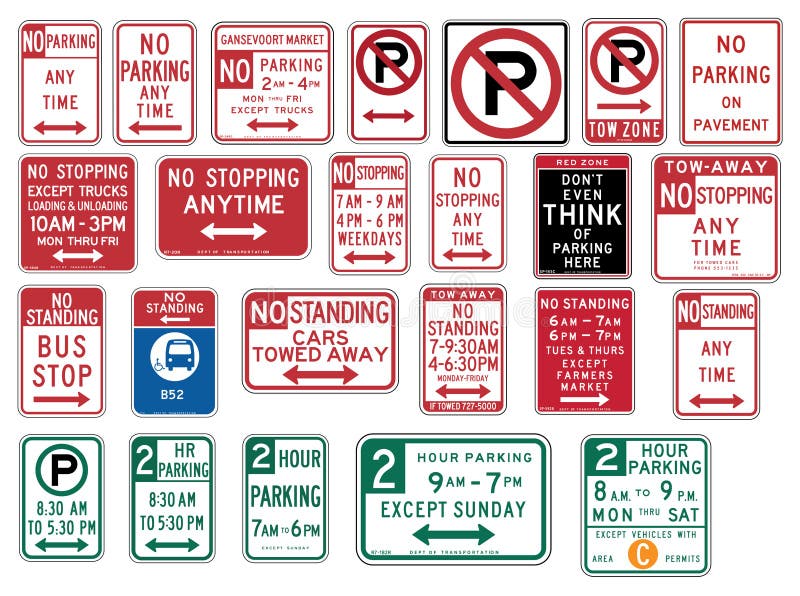
Free with trial Vector Illustration collection of the select Traffic Signs in the United States, isolated on white background. You can find other road signs in my portfolio. EPS file available. rnrnIn the United States, road signs are, for the most part, standardized by federal regulations, most notably in the Manual on Uniform Traffic Control Devices (MUTCD) and its companion volume the Standard Highway Signs (SHS). There currently are no plans for adopting the Vienna Convention on Road Signs and Signals standards. rnTwenty-three states along with the District of Columbia and Puerto Rico use the manual without any alterations, 20 states have adopted it in conjunction with a supplemental volume, and seven states have a state version in substantial conformance to the MUTCD. There are also localized versions that are used in large cities such as New York City which use a naming system compatible with the MUTCD and/or state supplement. The MUTCD and SHS establish seven general categories of signs for road and highway use. rnrnIncluded illustrations are select examples of the following MUTCD categories:rn-- R7 Series: Parkingrnrn. Adopted vectors Traffic Signs in the United States - No Parking. Vector Illustration collection of the select Traffic Signs in the United States, isolated on white background. Vector Illustration collection of the select Traffic Signs in the United States, isolated on white background. You can find other road signs in my portfolio. EPS file available.rnrnIn the United States, road signs are, for the most part, standardized by federal regulations, most notably in the Manual on Uniform Traffic Control Devices (MUTCD) and its companion volume the Standard Highway Signs (SHS). There currently are no plans for adopting the Vienna Convention on Road Signs and Signals standards.rnTwenty-three states along with the District of Columbia and Puerto Rico use the manual without any alterations, 20 states have adopted it in conjunction with a supplemental volume, and seven states have a state version in substantial conformance to the MUTCD. There are also localized versions that are used in large cities such as New York City which use a naming system compatible with the MUTCD and/or state supplement. The MUTCD and SHS establish seven general categories of signs for road and highway use.rnrnIncluded illustrations are select examples of the following MUTCD categories:rn-- R7 Series: Parkingrnrn
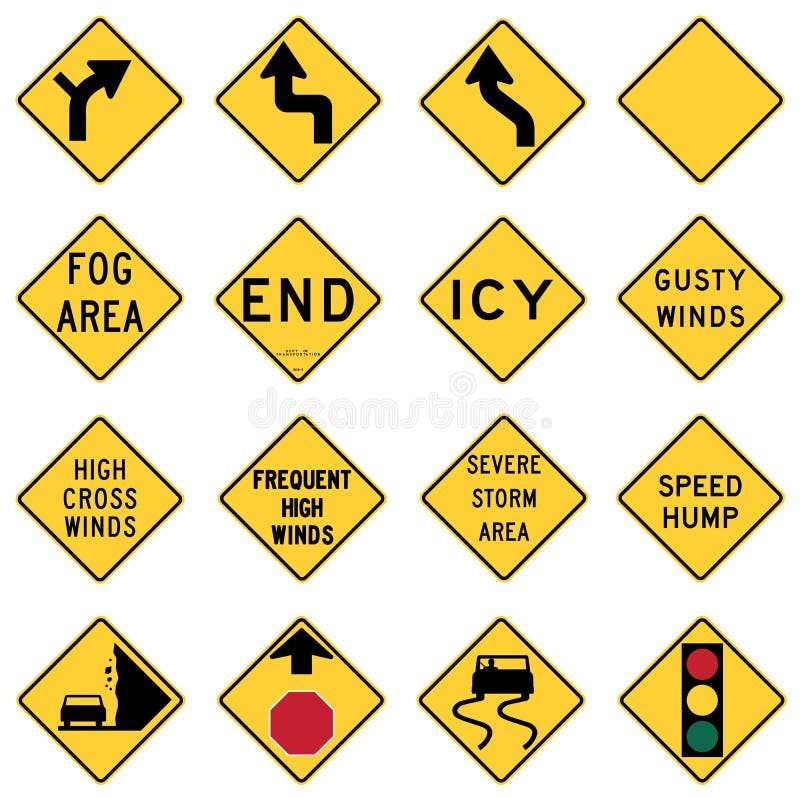
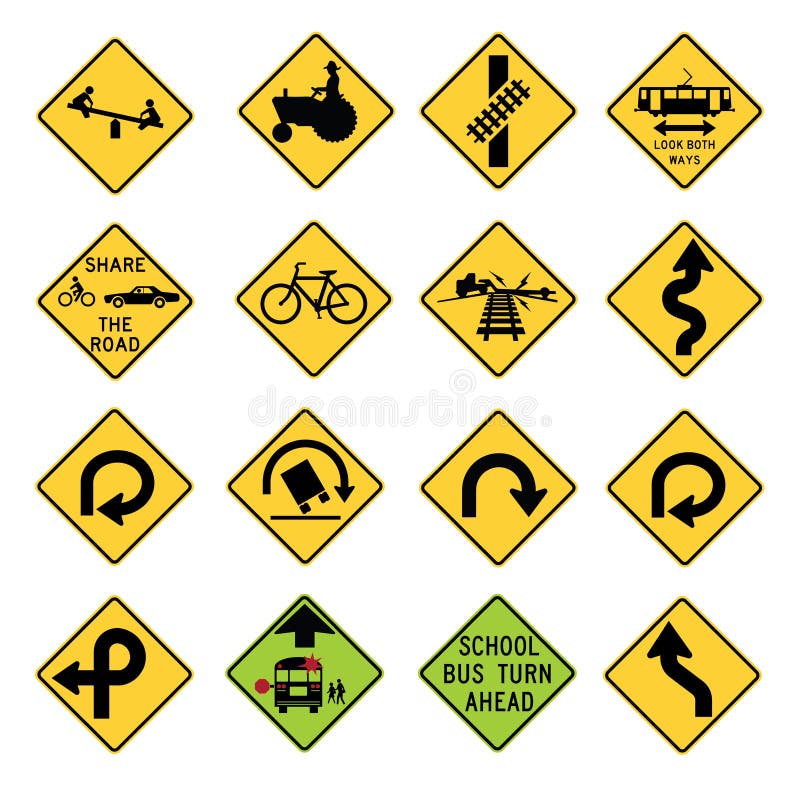
Free with trial Vector Illustration collection of the select Traffic Signs in the United States, isolated on white background. You can find other road signs in my portfolio. EPS file available. Warning signs are found in the W series of the national MUTCD. They highlight existing conditions, such as a curve, school, dead end street, or traffic signal. They can also warn possible danger such as bumps, bicycles, low flying aircraft or emergency vehicles. These signs are either yellow or fluorescent yellow in color and with the exception of a few signs are usually diamond shaped and sometimes have square or rectangular smaller signs or plaques associated with them. Most W series signs can also be found in with orange backgrounds, for temporary use in situations such as construction zones. Some of the temporary use signs are only for use in temporary situations. In the United States, road signs are, for the most part, standardized by federal regulations, most notably in the Manual on Uniform Traffic Control Devices (MUTCD) and its companion volume the Standard Highway Signs (SHS). There currently are no plans for adopting the Vienna Convention on Road Signs and Signals standards. Twenty-three states along with the District of Columbia and Puerto Rico use the manual without any alterations, 20 states have adopted it in conjunction with a supplemental volume, and seven states have a state version in substantial conformance to the MUTCD. There are also localized versions that are used in large cities such as New York City which use a naming system compatible with the MUTCD and/or state supplement. The MUTCD and SHS establish seven general categories of signs for road and highway use. Included illustrations are select examples of the MUTCD Warning Signs categories. Adopted vectors Traffic Warning Signs in the United States. Vector Illustration collection of the select Traffic Signs in the United States, isolated on white background. You. Vector Illustration collection of the select Traffic Signs in the United States, isolated on white background. You can find other road signs in my portfolio. EPS file available. Warning signs are found in the W series of the national MUTCD. They highlight existing conditions, such as a curve, school, dead end street, or traffic signal. They can also warn possible danger such as bumps, bicycles, low flying aircraft or emergency vehicles. These signs are either yellow or fluorescent yellow in color and with the exception of a few signs are usually diamond shaped and sometimes have square or rectangular smaller signs or plaques associated with them. Most W series signs can also be found in with orange backgrounds, for temporary use in situations such as construction zones. Some of the temporary use signs are only for use in temporary situations. In the United States, road signs are, for the most part, standardized by federal regulations, most notably in the Manual on Uniform Traffic Control Devices (MUTCD) and its companion volume the Standard Highway Signs (SHS). There currently are no plans for adopting the Vienna Convention on Road Signs and Signals standards. Twenty-three states along with the District of Columbia and Puerto Rico use the manual without any alterations, 20 states have adopted it in conjunction with a supplemental volume, and seven states have a state version in substantial conformance to the MUTCD. There are also localized versions that are used in large cities such as New York City which use a naming system compatible with the MUTCD and/or state supplement. The MUTCD and SHS establish seven general categories of signs for road and highway use. Included illustrations are select examples of the MUTCD Warning Signs categories.
Free with trial Vector Illustration collection of the select Traffic Signs in the United States, isolated on white background. You can find other road signs in my portfolio. EPS file available. Warning signs are found in the W series of the national MUTCD. They highlight existing conditions, such as a curve, school, dead end street, or traffic signal. They can also warn possible danger such as bumps, bicycles, low flying aircraft or emergency vehicles. These signs are either yellow or fluorescent yellow in color and with the exception of a few signs are usually diamond shaped and sometimes have square or rectangular smaller signs or plaques associated with them. Most W series signs can also be found in with orange backgrounds, for temporary use in situations such as construction zones. Some of the temporary use signs are only for use in temporary situations. In the United States, road signs are, for the most part, standardized by federal regulations, most notably in the Manual on Uniform Traffic Control Devices (MUTCD) and its companion volume the Standard Highway Signs (SHS). There currently are no plans for adopting the Vienna Convention on Road Signs and Signals standards. Twenty-three states along with the District of Columbia and Puerto Rico use the manual without any alterations, 20 states have adopted it in conjunction with a supplemental volume, and seven states have a state version in substantial conformance to the MUTCD. There are also localized versions that are used in large cities such as New York City which use a naming system compatible with the MUTCD and/or state supplement. The MUTCD and SHS establish seven general categories of signs for road and highway use. Included illustrations are select examples of the MUTCD Warning Signs categories. Adopted vectors Traffic Warning Signs in the United States. Vector Illustration collection of the select Traffic Signs in the United States, isolated on white background. You. Vector Illustration collection of the select Traffic Signs in the United States, isolated on white background. You can find other road signs in my portfolio. EPS file available. Warning signs are found in the W series of the national MUTCD. They highlight existing conditions, such as a curve, school, dead end street, or traffic signal. They can also warn possible danger such as bumps, bicycles, low flying aircraft or emergency vehicles. These signs are either yellow or fluorescent yellow in color and with the exception of a few signs are usually diamond shaped and sometimes have square or rectangular smaller signs or plaques associated with them. Most W series signs can also be found in with orange backgrounds, for temporary use in situations such as construction zones. Some of the temporary use signs are only for use in temporary situations. In the United States, road signs are, for the most part, standardized by federal regulations, most notably in the Manual on Uniform Traffic Control Devices (MUTCD) and its companion volume the Standard Highway Signs (SHS). There currently are no plans for adopting the Vienna Convention on Road Signs and Signals standards. Twenty-three states along with the District of Columbia and Puerto Rico use the manual without any alterations, 20 states have adopted it in conjunction with a supplemental volume, and seven states have a state version in substantial conformance to the MUTCD. There are also localized versions that are used in large cities such as New York City which use a naming system compatible with the MUTCD and/or state supplement. The MUTCD and SHS establish seven general categories of signs for road and highway use. Included illustrations are select examples of the MUTCD Warning Signs categories.
Free with trial A caucasian couple with black skinned child. Digital illustration about international adoption. Adopted vectors Adoption illustration. A caucasian couple with black skinned child. Digital illustration about international adoption. A caucasian couple with black skinned child. Digital illustration about international adoption.
Free with trial Kids Drawing. Family. With grandfather, grandmother, father, mother, son, daugther and baby. Adopted vectors Kids Drawing. Family. With grandfather, grandmother, father, mother, son, daugther and baby
Free with trial Small girl showing good grade to her mother / teacher / aunt. Stylized cartoon illustration. Adopted vectors Small cute child come to home with good grades. Small girl showing good grade to her mother / teacher / aunt. Stylized cartoon illustration. Small girl showing good grade to her mother / teacher / aunt. Stylized cartoon illustration.
Free with trial The wai has been adopted by western cultural symbols in Thailand, sawasdee. Adopted vectors Sawasdee thailand. The wai has been adopted by western cultural symbols in Thailand, sawasdee. The wai has been adopted by western cultural symbols in Thailand, sawasdee.
Free with trial Adoption. Hand drawn picture of new parents holding adopted child. Illustrated in a loose style. Vector eps available. Adopted vectors Adoption. Hand drawn picture of new parents holding adopted child. Illustrated in a loose style. Vector eps available
Free with trial Running greyhound. Silhouette of running adopted greyhound. Adopted vectors Running greyhound. Silhouette of running adopted greyhound
Free with trial Illustration of the new flag of Lesotho, adopted on October 4, 2006. Adopted vectors Lesotho official new flag. Illustration of the new flag of Lesotho, adopted on October 4, 2006. Illustration of the new flag of Lesotho, adopted on October 4, 2006.
Free with trial Illustration of helping hand design isolated on white background. Adopted vectors Helping hand. Illustration of helping hand design isolated on white background. Illustration of helping hand design isolated on white background.
Free with trial Kids Drawing. Family. Family with the father, mother and three children. Adopted vectors Kids Drawing. Family. Family with the father, mother and three children
Free with trial The black sheep. Abstract colorful illustration with clouds, small butterflies, trees, small bees and herd of sheep. One black sheep between herd of white sheep. Adopted vectors The black sheep. Abstract colorful illustration with clouds, small butterflies, trees, small bees and herd of sheep. One black sheep between herd of white sheep
Free with trial Two figures help a third figure reach for the stars. Adopted vectors Reach for your dreams. Two figures help a third figure reach for the stars. Two figures help a third figure reach for the stars.
Free with trial Vector doodle family - cartoon illustration in hand drawn style. Adopted vectors Doodle family - mother, father and kid. Vector doodle family - cartoon illustration in hand drawn style. Vector doodle family - cartoon illustration in hand drawn style.
Free with trial Family set with gay couple, two dads and kids. Characters in cartoon flat style. Vector illustration of family portrait isolated on white background. Adopted vectors Family set with gay couple, two dads and kids. Characters in cartoon flat style. Vector illustration of family portrait isolated on white background
Free with trial Fussy eater. Mother spoon-feeds the child, but child does not want to eat. Adopted vectors Fussy eater. Mother spoon-feeds the child, but child does not want to eat
Free with trial Afro American babysitter or stepsister playing educational game together with baby boy, building stack up ring pyramid toy. Multi-ethnic family mom and toddler son. Flat vector isolated illustration. Adopted vectors Afro American babysitter playing with baby boy. Afro American babysitter or stepsister playing educational game together with baby boy, building stack up ring. Afro American babysitter or stepsister playing educational game together with baby boy, building stack up ring pyramid toy. Multi-ethnic family mom and toddler son. Flat vector isolated illustration.
Free with trial Adult and child holding hands icon. Vector thin line illustration. Humanitarian help, adopting a child, family ties, child poverty awareness, social issues, charity and donation. Adopted vectors Adult and child holding hands icon. Vector thin line illustration. Humanitarian help, adopting a child, family ties. Child poverty awareness, social issues
Free with trial Nine hand painted heart outline variations stand in a single horizontal row on a clean white background. Every contour comes from a different brush stroke: some look bold and glossy, others dry, feathered, rough or grunge textured, while a few fade into translucent blush tints. The palette moves from vivid scarlet and classic red through coral and salmon toward pale pink, giving the sequence a natural rhythm. Doubled loops, splattered gaps and sketched edges imitate real ink on paper, so every symbol keeps the spontaneous charm of a quick doodle while remaining perfectly crisp. The heart shape ranks among the most recognized emblems on Earth. Medieval manuscripts and tapestries began linking it with courtly affection, playing cards adopted it as a suit in fifteenth century France, and Victorian valentine greetings turned it into a mass market icon. Today people draw it on napkins, cakes, foggy windows and sand, while emoji keyboards spread it through countless chats daily. Its meaning crosses languages: Herz or Herzen in German, corazon in Spanish, coeur in French, cuore in Italian. Composition remains flexible. Equal spacing lets designers isolate an individual figure, recolor it or combine several hearts into borders, frames, patterns and confetti. Varying thickness produces an organic feel, ideal when geometric forms would seem cold. Generous margins above and below allow headlines, names or dates to sit comfortably beside the artwork. Commercial uses are endless. Wedding planners and stationery studios can decorate invitations, save the date notices, menus, seating charts, thank you notes and guest books. Florists, jewelers, chocolatiers, perfumers and lingerie brands promoting February collections gain an instantly readable ornament for banners, tags, ribbons, gift wrap and boxes. Greeting card publishers, scrapbooking suppliers and craft retailers may print it on envelopes, stickers, washi tape, stamps and diaries. Apparel and textile companies could transfer the outlines onto T shirts, pillows, aprons, tote bags, socks and infant clothes, while tattoo artists treat them as ready flash references. Web and app developers will find them handy for like buttons, dating platforms, wellness trackers, social media graphics, stories, newsletters and blog headers. Charities, hospitals and cardiology clinics raising awareness about cardiac health or blood donation also benefit, as do educators preparing kindergarten worksheets and classroom decorations. Conceptually, each motif expresses love, passion, care, kindness, gratitude, friendship and devotion. Imperfect lines suggest authenticity, vulnerability and sincerity, reminding viewers that genuine feelings rarely appear polished. Lighter pastel versions evoke tenderness, nostalgia or a fading memory, whereas saturated cherry pieces shout desire and commitment. Together they can illustrate relationship stages, anniversaries, engagement announcements, mental wellbeing support or self acceptance campaigns. Technically, the file is a fully scalable graphic, so every element enlarges from a tiny favicon to a billboard without pixelation or blurring. Paths can be edited, recolored, separated or merged in Adobe Illustrator, Inkscape, Affinity Designer or CorelDRAW. Simple solid swatches switch to gold foil, black or brand palettes within seconds, and a raster preview accompanies the editable source for fast placement in Canva, PowerPoint, Keynote or Google Slides. Freehand aesthetics continue trending across branding, packaging and editorial illustration, because audiences crave warmth after years of flat, sterile pictograms. Calligraphic lettering, sketch journaling, boho posters and minimalist line art all pair naturally with this set. Makers using cutting plotters such as Cricut or Silhouette can trace these contours for vinyl decals, while embroidery digitizers, laser engravers, ceramic painters and cake decorators adapt them for fabric, wood, mugs and fondant. Teachers running drawing lessons can reproduce the collection as tracing practice, coloring pages or fine motor exercises, and therapists working with children may use them to discuss emotions. Psychologists associate crimson hues with energy, urgency and attraction, which explains why merchants rely on them during sales seasons. Softer rosy shades communicate gentleness, calm and youth, so combining both intensities in one series offers options for loud promotions and delicate personal messages alike. Seasonal marketers can extend usage beyond Valentines to Mothers Day, birthdays, baby showers, bridal parties, retirement farewells and charity drives. Pride events, Galentines brunches, family reunions, school fundraisers and volunteer appreciation weeks are further occasions where an affectionate accent fits. Small businesses such as bakeries, candle producers, soap workshops and cosmetic startups often choose such symbols for logos, labels and loyalty programs, because they convey attentiveness and craftsmanship without words. Adopted vectors Heart outline red hearts brush stroke line sketch love pink graphic background white valentine wedding doodle hand drawn. Nine hand painted heart outline. Nine hand painted heart outline variations stand in a single horizontal row on a clean white background. Every contour comes from a different brush stroke: some look bold and glossy, others dry, feathered, rough or grunge textured, while a few fade into translucent blush tints. The palette moves from vivid scarlet and classic red through coral and salmon toward pale pink, giving the sequence a natural rhythm. Doubled loops, splattered gaps and sketched edges imitate real ink on paper, so every symbol keeps the spontaneous charm of a quick doodle while remaining perfectly crisp.The heart shape ranks among the most recognized emblems on Earth. Medieval manuscripts and tapestries began linking it with courtly affection, playing cards adopted it as a suit in fifteenth century France, and Victorian valentine greetings turned it into a mass market icon. Today people draw it on napkins, cakes, foggy windows and sand, while emoji keyboards spread it through countless chats daily. Its meaning crosses languages: Herz or Herzen in German, corazon in Spanish, coeur in French, cuore in Italian.Composition remains flexible. Equal spacing lets designers isolate an individual figure, recolor it or combine several hearts into borders, frames, patterns and confetti. Varying thickness produces an organic feel, ideal when geometric forms would seem cold. Generous margins above and below allow headlines, names or dates to sit comfortably beside the artwork.Commercial uses are endless. Wedding planners and stationery studios can decorate invitations, save the date notices, menus, seating charts, thank you notes and guest books. Florists, jewelers, chocolatiers, perfumers and lingerie brands promoting February collections gain an instantly readable ornament for banners, tags, ribbons, gift wrap and boxes. Greeting card publishers, scrapbooking suppliers and craft retailers may print it on envelopes, stickers, washi tape, stamps and diaries. Apparel and textile companies could transfer the outlines onto T shirts, pillows, aprons, tote bags, socks and infant clothes, while tattoo artists treat them as ready flash references. Web and app developers will find them handy for like buttons, dating platforms, wellness trackers, social media graphics, stories, newsletters and blog headers. Charities, hospitals and cardiology clinics raising awareness about cardiac health or blood donation also benefit, as do educators preparing kindergarten worksheets and classroom decorations.Conceptually, each motif expresses love, passion, care, kindness, gratitude, friendship and devotion. Imperfect lines suggest authenticity, vulnerability and sincerity, reminding viewers that genuine feelings rarely appear polished. Lighter pastel versions evoke tenderness, nostalgia or a fading memory, whereas saturated cherry pieces shout desire and commitment. Together they can illustrate relationship stages, anniversaries, engagement announcements, mental wellbeing support or self acceptance campaigns.Technically, the file is a fully scalable graphic, so every element enlarges from a tiny favicon to a billboard without pixelation or blurring. Paths can be edited, recolored, separated or merged in Adobe Illustrator, Inkscape, Affinity Designer or CorelDRAW. Simple solid swatches switch to gold foil, black or brand palettes within seconds, and a raster preview accompanies the editable source for fast placement in Canva, PowerPoint, Keynote or Google Slides.Freehand aesthetics continue trending across branding, packaging and editorial illustration, because audiences crave warmth after years of flat, sterile pictograms. Calligraphic lettering, sketch journaling, boho posters and minimalist line art all pair naturally with this set.Makers using cutting plotters such as Cricut or Silhouette can trace these contours for vinyl decals, while embroidery digitizers, laser engravers, ceramic painters and cake decorators adapt them for fabric, wood, mugs and fondant. Teachers running drawing lessons can reproduce the collection as tracing practice, coloring pages or fine motor exercises, and therapists working with children may use them to discuss emotions.Psychologists associate crimson hues with energy, urgency and attraction, which explains why merchants rely on them during sales seasons. Softer rosy shades communicate gentleness, calm and youth, so combining both intensities in one series offers options for loud promotions and delicate personal messages alike. Seasonal marketers can extend usage beyond Valentines to Mothers Day, birthdays, baby showers, bridal parties, retirement farewells and charity drives. Pride events, Galentines brunches, family reunions, school fundraisers and volunteer appreciation weeks are further occasions where an affectionate accent fits. Small businesses such as bakeries, candle producers, soap workshops and cosmetic startups often choose such symbols for logos, labels and loyalty programs, because they convey attentiveness and craftsmanship without words.
Free with trial Cute cartoon hen with chickens sitting in a nest. Illustration of Cute cartoon hen with chickens sitting in a nest. Adopted vectors Cute cartoon hen with chickens sitting in a nest. Illustration of Cute cartoon hen with chickens sitting in a nest
Free with trial Adopt a Child. Hand with Heart Line Icon. Volunteer Help Care Protection Support Theme. Child Adoption Sign and Symbol. Adopted vectors Adopt a Child. Hand with Heart Line Icon. Volunteer Help Care Protection Support Theme. Child Adoption Sign and Symbol. Adopt a Child. Hand with Heart Line Icon
Free with trial The silhouette Zia symbol is a visually striking and culturally significant representation that holds great meaning in the state of New Mexico, USA. It features a stylized depiction of the sun with rays radiating outward in a circular pattern. The Zia symbol has a simple yet powerful design, with four groups of four rays each, totaling 16 rays in all. This symbol holds deep significance for the Zia Pueblo Native American tribe, whose ancestors have lived in the region for centuries. It is a sacred emblem that embodies the tribe's core values and beliefs, including the sacred number four. The number four represents various aspects of life, such as the four cardinal directions (north, south, east, and west), the four seasons, the four stages of life, and the four sacred obligations: to have a strong body, a clear mind, a pure spirit, and a devotion to the welfare of others. In 1925, the Zia symbol was adopted as the official symbol of the state of New Mexico. It now serves as a powerful representation of the state's unique cultural heritage and reflects the spirit of unity, harmony, and respect for nature. Visually, the silhouette Zia symbol is instantly recognizable and often seen on various official documents, signs, and flags throughout the state. Its enduring presence serves as a reminder of New Mexico's rich Native American history and the profound interconnectedness of all living things. Adopted vectors Zia symbol silhouette vector art. The silhouette Zia symbol is a visually striking and culturally significant representation that holds great meaning in the. The silhouette Zia symbol is a visually striking and culturally significant representation that holds great meaning in the state of New Mexico, USA. It features a stylized depiction of the sun with rays radiating outward in a circular pattern. The Zia symbol has a simple yet powerful design, with four groups of four rays each, totaling 16 rays in all.This symbol holds deep significance for the Zia Pueblo Native American tribe, whose ancestors have lived in the region for centuries. It is a sacred emblem that embodies the tribe's core values and beliefs, including the sacred number four. The number four represents various aspects of life, such as the four cardinal directions (north, south, east, and west), the four seasons, the four stages of life, and the four sacred obligations: to have a strong body, a clear mind, a pure spirit, and a devotion to the welfare of others.In 1925, the Zia symbol was adopted as the official symbol of the state of New Mexico. It now serves as a powerful representation of the state's unique cultural heritage and reflects the spirit of unity, harmony, and respect for nature.Visually, the silhouette Zia symbol is instantly recognizable and often seen on various official documents, signs, and flags throughout the state. Its enduring presence serves as a reminder of New Mexico's rich Native American history and the profound interconnectedness of all living things.
Free with trial Happy couple of man and woman holding their adopted children. Step parents. Happy foster family, mom, dad and children, a boy and a girl. Vector Illustration. Adopted vectors Mother and father hug their adopted children. Happy foster family, parents, mom, dad and children. Vector Illustration. Happy couple of man and woman holding. Happy couple of man and woman holding their adopted children. Step parents. Happy foster family, mom, dad and children, a boy and a girl. Vector Illustration
Free with trial Lesbian Couple Adoption. Young lesbian couple sitting on a couch holding and hugging adopted african baby. Adopted vectors Lesbian Couple Adoption. Young lesbian couple sitting on a couch holding and hugging adopted african baby
Free with trial Vector illustration of Family number 6 Isolated. Foster care or Adoption. Adopted vectors Family 6 Isolated Adopted. Vector illustration of Family number 6 Isolated. Foster care or Adoption. Vector illustration of Family number 6 Isolated. Foster care or Adoption.
Free with trial Vector illustration of Family number 7 Isolated. Foster care or Adoption. Adopted vectors Family 7 Isolated Adopted. Vector illustration of Family number 7 Isolated. Foster care or Adoption. Vector illustration of Family number 7 Isolated. Foster care or Adoption.
Free with trial Married Couple International Adoption. Young married couple holding and hugging cute international adopted asian daughter. Adopted vectors Married Couple International Adoption. Young married couple holding and hugging cute international adopted asian daughter
Free with trial Scene of kid adoption. Multicultural foster families and couples adopt diverse children. Happy parents embracing their adopted daughters and sons. Flat vector cartoon illustration isolated on white. Adopted vectors Scene of kid adoption. Multicultural foster families and couples adopt diverse children. Happy parents embracing their. Adopted daughters and sons. Flat vector. Scene of kid adoption. Multicultural foster families and couples adopt diverse children. Happy parents embracing their adopted daughters and sons. Flat vector cartoon illustration isolated on white.
Free with trial Handicapped man in wheelchair. Injured character rehabilitation. Assistive technology, devices for disabled people, adopted technologies concept. Bright vibrant violet vector isolated illustration. Adopted vectors Assistive technology concept vector illustration. Handicapped man in wheelchair. Injured character rehabilitation. Assistive technology, devices for disabled. Handicapped man in wheelchair. Injured character rehabilitation. Assistive technology, devices for disabled people, adopted technologies concept. Bright vibrant violet vector isolated illustration
Free with trial He Parental Advisory label is a warning label introduced by the Recording Industry Association of America in 1985 and adopted by the British Phonographic Industry in 2011. Adopted vectors Parental Advisory Explicit Content logo. He Parental Advisory label is a warning label introduced by the Recording Industry Association of America in 1985 and. He Parental Advisory label is a warning label introduced by the Recording Industry Association of America in 1985 and adopted by the British Phonographic Industry in 2011
Free with trial Kids Drawing. Family in the winter. Family: the father, mum, the daughter and the son in warm clothes walk in the winter under snow. Adopted vectors Kids Drawing. Family in the winter. Family: the father, mum, the daughter and the son in warm clothes walk in the winter under snow
Free with trial Green tick marking on the check box. Close up look at green tick marking on the check box. Adopted vectors Green tick marking on the check box. Close up look at green tick marking on the check box
Free with trial Kids Drawing. Family. With grandfather, grandmother, father, mother, two sons, two daughters and baby. Adopted vectors Kids Drawing. Family. With grandfather, grandmother, father, mother, two sons, two daughters and baby
Free with trial Set of speakers. Vector illustration. Images adopted for both light and dark backgrounds. Nice for such themes as music, studio, audio equipment, clubbing, party etc. Adopted vectors Loudspeakers. Set of speakers. Vector illustration. Images adopted for both light and dark backgrounds. Nice for such themes as music, studio, audio equipment. Set of speakers. Vector illustration. Images adopted for both light and dark backgrounds. Nice for such themes as music, studio, audio equipment, clubbing, party etc.
Free with trial Red and green button. Red button with a negative and positive gesture. Adopted vectors Red and green button. Red button with a negative and positive gesture
Free with trial Dog paw heart love sign icon. Pets symbol textured web button. Vector Grunge post stamp. Circle banner or label. Protect your dog. Or cat symbol. Adopted vectors Dog paw heart love sign icon. Pets symbol textured web button. Vector Grunge post stamp. Circle banner or label. Protect your dog. Or cat symbol
Free with trial Dog and cat adoption banner poster design element and hand drawn calligraphy lettering. Pet shelter, homeless animals vector flat cartoon illustration. Adopted vectors Dog and cat adoption banner poster design element and lettering. Pet shelter, homeless animals vector illustration. Dog and cat adoption banner poster design. Dog and cat adoption banner poster design element and hand drawn calligraphy lettering. Pet shelter, homeless animals vector flat cartoon illustration
Free with trial Pet shelter vector flat illustration. Adoption of homeless animals concept. Mom and daughter adopt cute dog from shelter. Adopted vectors Pet shelter vector flat illustration. Adoption of homeless animals concept. Mom and daughter adopt cute dog from shelter.
Free with trial Super Dog Vector Logo Cartoon. Blue super dog with a cape. Vector logo illustration. Adopted vectors Super Dog Vector Logo Cartoon.. Blue super dog with a cape. Vector logo illustration
Free with trial Isolated abstract colorful child and adult hand in hand logo set, kid touching parent palm logotype collection on white background. Adopted vectors Isolated abstract colorful child and adult hand in hand logo set, kid touching parent palm logotype collection on white. Background
Free with trial Vector and illustration: Pet therapy icon set. It included icons such as animal-assisted, mental, health, medical, rescue dog, clinic, and more. Adopted vectors Pet therapy icon set. It included icons such as animal assisted, mental, health, medical, rescue dog, clinic, and more. Vector and illustration: Pet therapy. Vector and illustration: Pet therapy icon set. It included icons such as animal-assisted, mental, health, medical, rescue dog, clinic, and more.
Free with trial Adopt a Child. Hand with Heart Line Icon. Volunteer Help Care Protection Support Theme. Child Adoption Sign and Symbol. Adopted vectors Adopt a Child. Hand with Heart Line Icon. Volunteer Help Care Protection Support Theme. Child Adoption Sign and Symbol. Adopt a Child. Hand with Heart Line Icon
Free with trial Blue Golden Retriever with Blue Circle Background Logo Design. Adopted vectors Blue Golden Retriever with Blue Circle Background Logo Design. Flat Blue Golden Retriever with Blue Circle Background Logo Design
Free with trial Pets icons. Dog paw and feces signs. Clean up after pets. Pets food. Circle concept web buttons. Vector. Adopted vectors Pets icons. Dog paw and feces signs. Clean up after pets. Pets food. Circle concept web buttons. Vector
Free with trial Young Couple Adopted Child. Lovely young married couple hugging little adopted asian child. Adopted vectors Young Couple Adopted Child. Lovely young married couple hugging little adopted asian child
Free with trial Adopted Daughter Family. Young married couple hugging and kissing their beautiful adopted asian little daughter. Adopted vectors Adopted Daughter Family. Young married couple hugging and kissing their beautiful adopted asian little daughter
Free with trial Mother hugs her adopted children, a girl and a boy. Step parent. Happy foster family, parent, mom, and kids. Vector Illustration. Adopted vectors Mother holding her adopted children. Cute foster family, parent, mom and kids. Vector Illustration. Mother hugs her adopted children, a girl and a boy. Step. Mother hugs her adopted children, a girl and a boy. Step parent. Happy foster family, parent, mom, and kids. Vector Illustration
Free with trial Foster family portrait. Happy mother, father and adopted kid. Smiling parents and adoptive child. Mom, dad and son. Children adoption concept. Flat vector illustration isolated on white background. Adopted vectors Foster family portrait. Happy mother, father and adopted kid. Smiling parents and adoptive child. Mom, dad and son. Children adoption concept. Flat vector
Free with trial Symbol of Chaos vector isolated on white background. A symbol originating from The Eternal Champion, later adopted by occultists and role-playing games. Aleister Crowley and chaos magic. Adopted vectors Symbol of Chaos vector isolated on white background. A symbol originating from The Eternal Champion, later adopted by occultists. And role-playing games. Symbol of Chaos vector isolated on white background. A symbol originating from The Eternal Champion, later adopted by occultists and role-playing games. Aleister Crowley and chaos magic
Free with trial Happy couple of man and woman holding their sleeping newborn adopted baby. Cute foster family, mom, dad and child. Vector Illustration. Adopted vectors Mother and father holding their adopted baby. Cute foster family, parents, mom, dad and child. Vector Illustration. Happy couple of man and woman holding their. Happy couple of man and woman holding their sleeping newborn adopted baby. Cute foster family, mom, dad and child. Vector Illustration
Free with trial Christian illustration. Light After Darkness. Adopted as the motto of the entire Protestant Reformation. Adopted vectors Light After Darkness. Adopted as the motto of the entire Protestant Reformation. Christian illustration. Light After Darkness. Adopted as the motto of the entire. Christian illustration. Light After Darkness. Adopted as the motto of the entire Protestant Reformation
Free with trial Christian illustration. Light After Darkness. Adopted as the motto of the entire Protestant Reformation. Adopted vectors Light After Darkness. Adopted as the motto of the entire Protestant Reformation. Christian illustration. Light After Darkness. Adopted as the motto of the entire. Christian illustration. Light After Darkness. Adopted as the motto of the entire Protestant Reformation
Free with trial Christian illustration. Light After Darkness. Adopted as the motto of the entire Protestant Reformation. Adopted vectors Light After Darkness. Adopted as the motto of the entire Protestant Reformation. Christian illustration. Light After Darkness. Adopted as the motto of the entire. Christian illustration. Light After Darkness. Adopted as the motto of the entire Protestant Reformation
Free with trial Symbol of Chaos vector isolated on white background. A symbol originating from The Eternal Champion, later adopted by occultists and role-playing games. Aleister Crowley and chaos magic. Adopted vectors Symbol of Chaos vector isolated on white background. A symbol originating from The Eternal Champion, later adopted by occultists. And role-playing games. Symbol of Chaos vector isolated on white background. A symbol originating from The Eternal Champion, later adopted by occultists and role-playing games. Aleister Crowley and chaos magic
Free with trial Foster family with adopted African child. Adoptive parents with kids. Happy international mother, father and sons. Adoption concept. Flat graphic vector illustration isolated on white background. Adopted vectors Foster family with adopted African child. Adoptive parents with kids. Happy international mother, father and sons. Adoption concept. Flat graphic vector
Free with trial Happy adopted kid son in foster family with mother and father. Boy and parents of different race. Wife, husband and adoptive black child. Flat vector illustration isolated on white background. Adopted vectors Happy adopted kid son in foster family with mother and father. Boy and parents of different race. Wife, husband and. Adoptive black child. Flat vector. Happy adopted kid son in foster family with mother and father. Boy and parents of different race. Wife, husband and adoptive black child. Flat vector illustration isolated on white background.
Free with trial Foster parent hugging adopted child. Happy family with adoptive kid. African mother and father with son of different race. Adoption concept. Flat vector illustration isolated on white background. Adopted vectors Foster parent hugging adopted child. Happy family with adoptive kid. African mother and father with son of different. Race. Adoption concept. Flat vector. Foster parent hugging adopted child. Happy family with adoptive kid. African mother and father with son of different race. Adoption concept. Flat vector illustration isolated on white background.
Free with trial Happy African American Gay Couple with adopted children. Gay parents. Flat style people. Adopted vectors Happy African American Gay Couple with adopted children. Gay parents. Flat style people
Free with trial Security measures adopted for the covid-19 crisis. Informative poster for business with the security measures adopted for the covid-19 crisis. Adopted vectors Security measures adopted for the covid-19 crisis. Informative poster for business with the security measures adopted for the covid-19 crisis
Free with trial Security measures adopted for the covid-19 crisis. Informative poster for business with the security measures adopted for the covid-19 crisis. Adopted vectors Security measures adopted for the covid-19 crisis. Informative poster for business with the security measures adopted for the covid-19 crisis
Free with trial Happy LGBT family spending time together and sitting on sofa, two guys adopted girl. Vector illustration. Adopted vectors Happy LGBT family spending time together and sitting on sofa, two guys adopted girl. Vector illustration
Free with trial Security measures adopted for the covid-19 crisis. Informative poster for business with the security measures adopted for the covid-19 crisis. Adopted vectors Security measures adopted for the covid-19 crisis. Informative poster for business with the security measures adopted for the covid-19 crisis
Free with trial Black parents hugging caucasian girl. Family with adopted child. Isolated on white background. Adopted vectors Black parents hugging caucasian girl. Family with adopted child. Isolated on white background
Free with trial Adopted family quote. Lettering about children adopting. Forever Loved poster. Text for Foster Parent. Adopted vectors Adopted family quote. Lettering about children adopting. Forever Loved poster. Text for Foster Parent. Adopted family quote. Lettering about children adopting
Free with trial Adopted dog logo. For dog rescue foundation, the logo with a dog bite a bone with pictural mark style. Adopted vectors Adopted dog logo. For dog rescue foundation, the logo with a dog bite a bone with pictural mark style
Free with trial Love makes a Family. Quote with rainbow for Adopting family. Lettering about children adopted. Heart, love for Foster. Parents. Adopted vectors Love makes a Family. Quote with rainbow for Adopting family. Lettering about children adopted. Heart, love for Foster. Parents
Free with trial Quote for Adopting family. Lettering about children adopted. Parenthood requires Love not DNA. Text for Foster Parent. Lettering. Adopted vectors Quote for Adopting family. Lettering about children adopted. Parenthood requires Love not DNA. Text for Foster Parent. Quote for Adopting family. Lettering
Free with trial Family kids adoption. Multicultural parents adopt child, adopted kid, love foster orphan children, charity relationship, mother care custod society support vector illustration family child or kid. Adopted vectors Family kids adoption. Multicultural parents adopt child, adopted kid, love foster orphan children, charity relationship. Mother care custod society support. Family kids adoption. Multicultural parents adopt child, adopted kid, love foster orphan children, charity relationship, mother care custod society support vector illustration family child or kid
Free with trial A charming and colorful hand-drawn lettering illustration with the heartwarming quote 'Adopted and Loved'. This playful doodle-style typography features vibrant letters decorated with hearts, paw prints, and stars on a clean white background. It's a perfect design to promote pet adoption, animal rescue, and the 'adopt don't shop' message. Ideal for use on posters, t-shirts, social media posts, stickers, and promotional materials for animal shelters, veterinary clinics, or any project celebrating the love for rescued pets. Vector art illustration for easy editing. Adopted vectors Adopted and Loved Pet Adoption Quote Lettering. A charming and colorful hand-drawn lettering illustration with the heartwarming quote 'Adopted and Loved'. This. A charming and colorful hand-drawn lettering illustration with the heartwarming quote 'Adopted and Loved'. This playful doodle-style typography features vibrant letters decorated with hearts, paw prints, and stars on a clean white background. It's a perfect design to promote pet adoption, animal rescue, and the 'adopt don't shop' message. Ideal for use on posters, t-shirts, social media posts, stickers, and promotional materials for animal shelters, veterinary clinics, or any project celebrating the love for rescued pets. Vector art illustration for easy editing.
Free with trial Adopted child glyph icon vector illustration. Adopted child glyph icon vector. adopted child sign. isolated contour symbol black illustration. Adopted vectors Adopted child glyph icon vector illustration. Adopted child glyph icon vector. adopted child sign. isolated contour symbol black illustration
Free with trial Dog Bone Chew Treats Collection. With Loved, Spoiled, Adored, Bribes, Adopted, Rescued and Treats Text, isolated on white background. Adopted vectors Dog Bone Chew Treats Collection. With Loved, Spoiled, Adored, Bribes, Adopted, Rescued and Treats Text, isolated on white background
Free with trial An image of a lesbian couple with their adopted child. Adopted vectors Lesbian Gay Adoption. An image of a lesbian couple with their adopted child. An image of a lesbian couple with their adopted child.
Free with trial Happy Gay Family. Happy gay couple family enjoying a day on the beach with their adopted black baby girl. Adopted vectors Happy Gay Family. Happy gay couple family enjoying a day on the beach with their adopted black baby girl
Free with trial An image of a two men with their adopted baby. Adopted vectors Gay Adoption. An image of a two men with their adopted baby. An image of a two men with their adopted baby.
Free with trial An image of a family excited about adoption. Adopted vectors Adopted At Last. An image of a family excited about adoption. An image of a family excited about adoption.
 Sign in