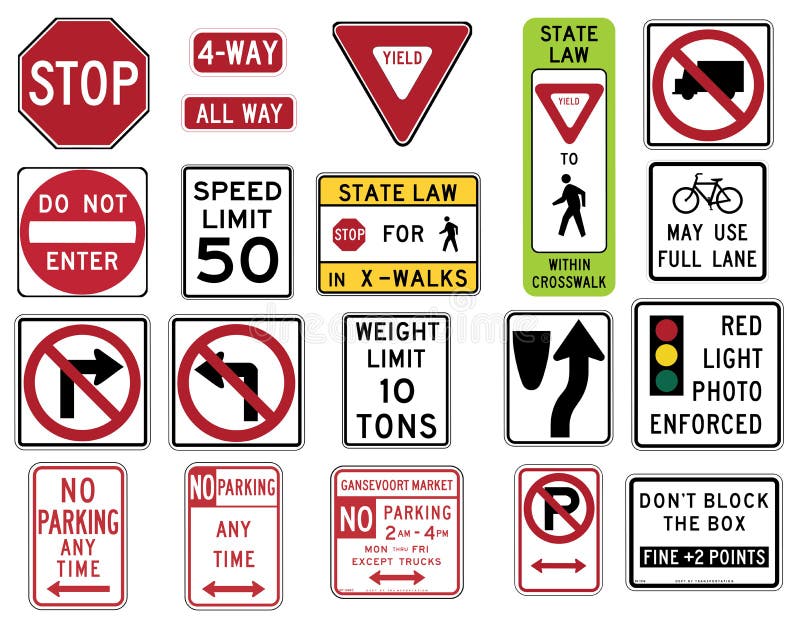
Free with trial Vector Illustration collection of the select Traffic Signs in the United States, isolated on white background. You can find other road signs in my portfolio. EPS file available. In the United States, road signs are, for the most part, standardized by federal regulations, most notably in the Manual on Uniform Traffic Control Devices (MUTCD) and its companion volume the Standard Highway Signs (SHS). There currently are no plans for adopting the Vienna Convention on Road Signs and Signals standards. Twenty-three states along with the District of Columbia and Puerto Rico use the manual without any alterations, 20 states have adopted it in conjunction with a supplemental volume, and seven states have a state version in substantial conformance to the MUTCD. There are also localized versions that are used in large cities such as New York City which use a naming system compatible with the MUTCD and/or state supplement. The MUTCD and SHS establish seven general categories of signs for road and highway use. Included illustrations are select examples of the following MUTCD categories: -- R1 Series STOP and YIELD -- R2 Series Speed Limit -- R3 Series Lane Usage and Turns (Left and Right Turn) -- R4 Regulation of Movement -- R5 Series: Exclusionary -- R7 Series: Parking. Conjunction vectors Traffic Signs in the United States - Regulatory Series. Vector Illustration collection of the select Traffic Signs in the United States, isolated on white. Vector Illustration collection of the select Traffic Signs in the United States, isolated on white background. You can find other road signs in my portfolio. EPS file available. In the United States, road signs are, for the most part, standardized by federal regulations, most notably in the Manual on Uniform Traffic Control Devices (MUTCD) and its companion volume the Standard Highway Signs (SHS). There currently are no plans for adopting the Vienna Convention on Road Signs and Signals standards. Twenty-three states along with the District of Columbia and Puerto Rico use the manual without any alterations, 20 states have adopted it in conjunction with a supplemental volume, and seven states have a state version in substantial conformance to the MUTCD. There are also localized versions that are used in large cities such as New York City which use a naming system compatible with the MUTCD and/or state supplement. The MUTCD and SHS establish seven general categories of signs for road and highway use. Included illustrations are select examples of the following MUTCD categories: -- R1 Series STOP and YIELD -- R2 Series Speed Limit -- R3 Series Lane Usage and Turns (Left and Right Turn) -- R4 Regulation of Movement -- R5 Series: Exclusionary -- R7 Series: Parking
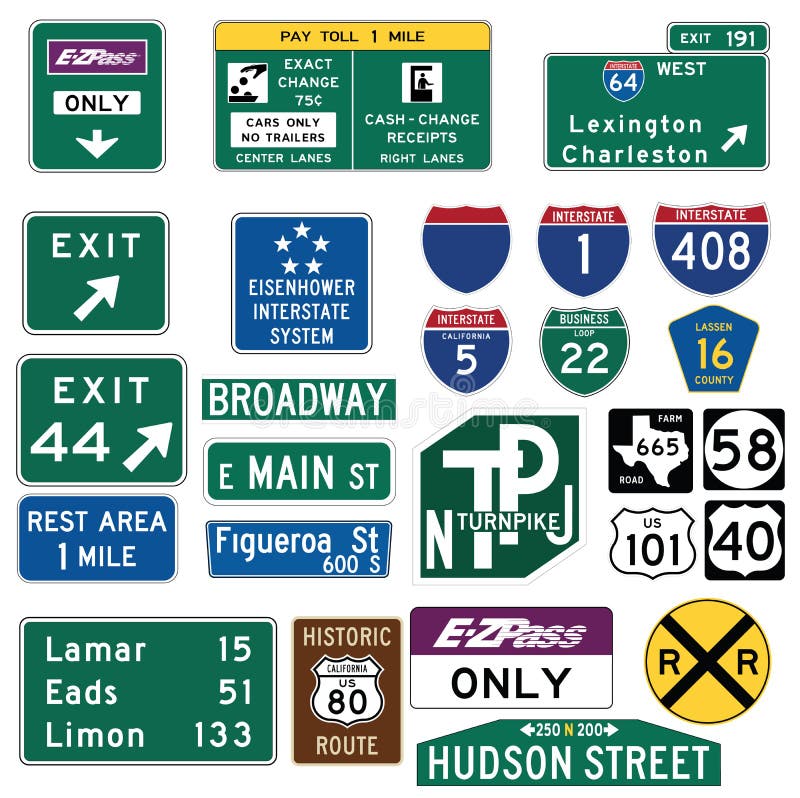
Free with trial Vector Illustration collection of the select Traffic Signs in the United States, isolated on white background. You can find other road signs in my portfolio. EPS file available. Guide signs are essential to direct road users along streets and highways, to inform them of intersecting routes, rnto direct them to cities, towns, villages, or other important destinations, to identify nearby rivers and streams, parks, forests, and historical sites, and generally to give such information as will help them along their way in the most simple, direct manner possible. rnrnIn the United States, road signs are, for the most part, standardized by federal regulations, most notably in the Manual on Uniform Traffic Control Devices (MUTCD) and its companion volume the Standard Highway Signs (SHS). There currently are no plans for adopting the Vienna Convention on Road Signs and Signals standards. Twenty-three states along with the District of Columbia and Puerto Rico use the manual without any alterations, 20 states have adopted it in conjunction with a supplemental volume, and seven states have a state version in substantial conformance to the MUTCD. There are also localized versions that are used in large cities such as New York City which use a naming system compatible with the MUTCD and/or state supplement. The MUTCD and SHS establish seven general categories of signs for road and highway use. rnrnIncluded illustrations are select examples of the MUTCD Guide Signs categories. rn. Conjunction vectors Traffic Guide Signs in the United States. Vector Illustration collection of the select Traffic Signs in the United States, isolated on white background. You can. Vector Illustration collection of the select Traffic Signs in the United States, isolated on white background. You can find other road signs in my portfolio. EPS file available. Guide signs are essential to direct road users along streets and highways, to inform them of intersecting routes, rnto direct them to cities, towns, villages, or other important destinations, to identify nearby rivers and streams, parks, forests, and historical sites, and generally to give such information as will help them along their way in the most simple, direct manner possible.rnrnIn the United States, road signs are, for the most part, standardized by federal regulations, most notably in the Manual on Uniform Traffic Control Devices (MUTCD) and its companion volume the Standard Highway Signs (SHS). There currently are no plans for adopting the Vienna Convention on Road Signs and Signals standards. Twenty-three states along with the District of Columbia and Puerto Rico use the manual without any alterations, 20 states have adopted it in conjunction with a supplemental volume, and seven states have a state version in substantial conformance to the MUTCD. There are also localized versions that are used in large cities such as New York City which use a naming system compatible with the MUTCD and/or state supplement. The MUTCD and SHS establish seven general categories of signs for road and highway use.rnrnIncluded illustrations are select examples of the MUTCD Guide Signs categories.rn
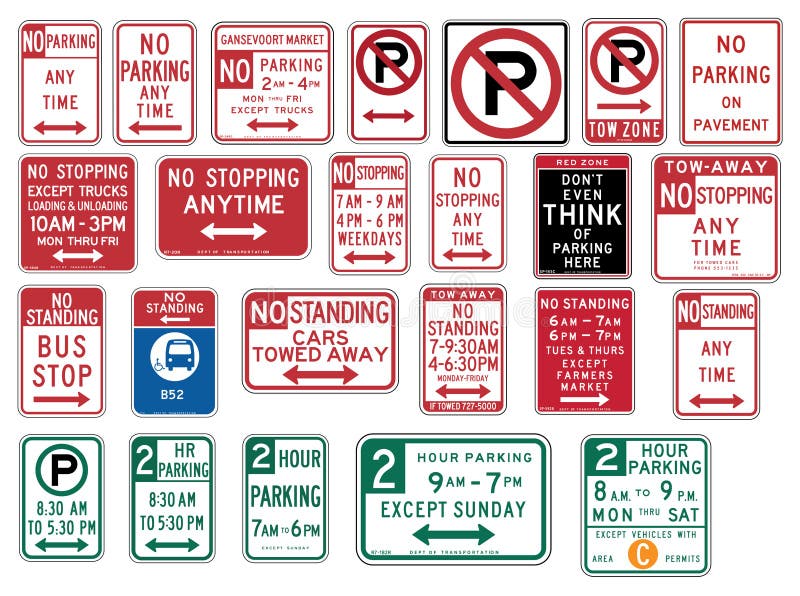
Free with trial Vector Illustration collection of the select Traffic Signs in the United States, isolated on white background. You can find other road signs in my portfolio. EPS file available. rnrnIn the United States, road signs are, for the most part, standardized by federal regulations, most notably in the Manual on Uniform Traffic Control Devices (MUTCD) and its companion volume the Standard Highway Signs (SHS). There currently are no plans for adopting the Vienna Convention on Road Signs and Signals standards. rnTwenty-three states along with the District of Columbia and Puerto Rico use the manual without any alterations, 20 states have adopted it in conjunction with a supplemental volume, and seven states have a state version in substantial conformance to the MUTCD. There are also localized versions that are used in large cities such as New York City which use a naming system compatible with the MUTCD and/or state supplement. The MUTCD and SHS establish seven general categories of signs for road and highway use. rnrnIncluded illustrations are select examples of the following MUTCD categories:rn-- R7 Series: Parkingrnrn. Conjunction vectors Traffic Signs in the United States - No Parking. Vector Illustration collection of the select Traffic Signs in the United States, isolated on white background. Vector Illustration collection of the select Traffic Signs in the United States, isolated on white background. You can find other road signs in my portfolio. EPS file available.rnrnIn the United States, road signs are, for the most part, standardized by federal regulations, most notably in the Manual on Uniform Traffic Control Devices (MUTCD) and its companion volume the Standard Highway Signs (SHS). There currently are no plans for adopting the Vienna Convention on Road Signs and Signals standards.rnTwenty-three states along with the District of Columbia and Puerto Rico use the manual without any alterations, 20 states have adopted it in conjunction with a supplemental volume, and seven states have a state version in substantial conformance to the MUTCD. There are also localized versions that are used in large cities such as New York City which use a naming system compatible with the MUTCD and/or state supplement. The MUTCD and SHS establish seven general categories of signs for road and highway use.rnrnIncluded illustrations are select examples of the following MUTCD categories:rn-- R7 Series: Parkingrnrn
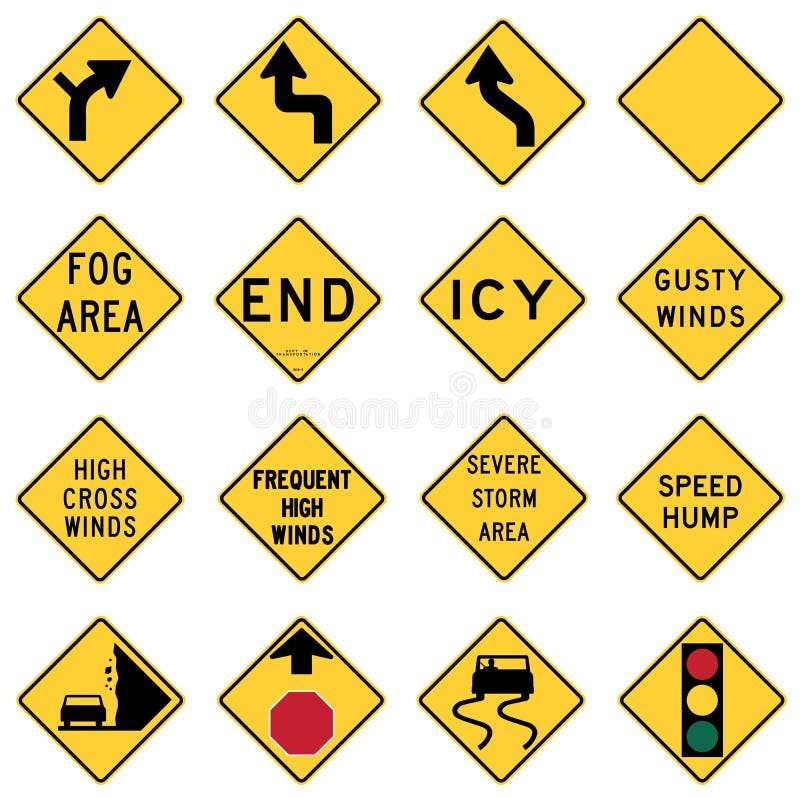
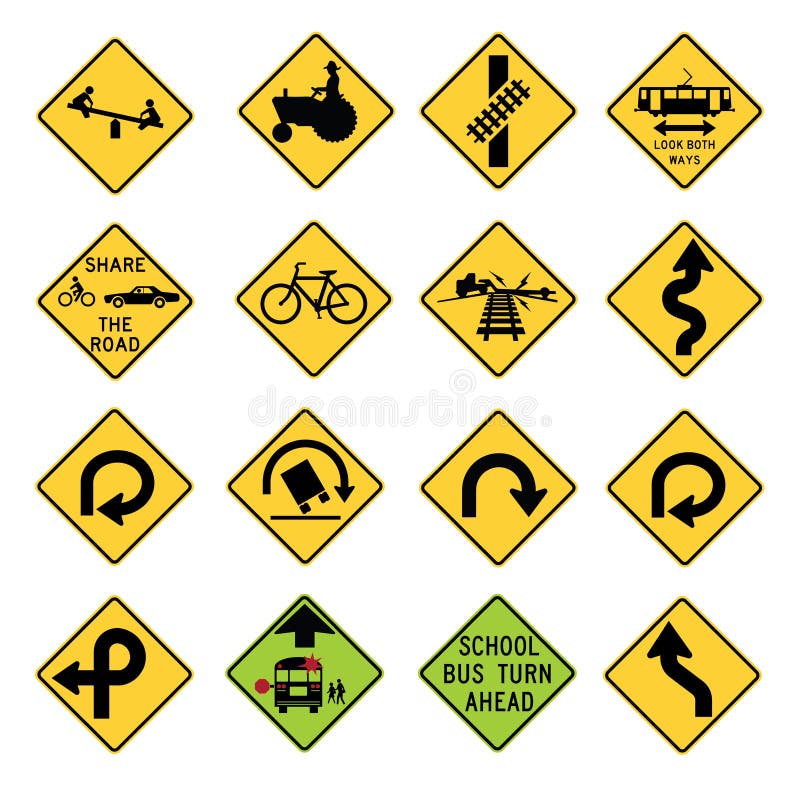
Free with trial Vector Illustration collection of the select Traffic Signs in the United States, isolated on white background. You can find other road signs in my portfolio. EPS file available. Warning signs are found in the W series of the national MUTCD. They highlight existing conditions, such as a curve, school, dead end street, or traffic signal. They can also warn possible danger such as bumps, bicycles, low flying aircraft or emergency vehicles. These signs are either yellow or fluorescent yellow in color and with the exception of a few signs are usually diamond shaped and sometimes have square or rectangular smaller signs or plaques associated with them. Most W series signs can also be found in with orange backgrounds, for temporary use in situations such as construction zones. Some of the temporary use signs are only for use in temporary situations. In the United States, road signs are, for the most part, standardized by federal regulations, most notably in the Manual on Uniform Traffic Control Devices (MUTCD) and its companion volume the Standard Highway Signs (SHS). There currently are no plans for adopting the Vienna Convention on Road Signs and Signals standards. Twenty-three states along with the District of Columbia and Puerto Rico use the manual without any alterations, 20 states have adopted it in conjunction with a supplemental volume, and seven states have a state version in substantial conformance to the MUTCD. There are also localized versions that are used in large cities such as New York City which use a naming system compatible with the MUTCD and/or state supplement. The MUTCD and SHS establish seven general categories of signs for road and highway use. Included illustrations are select examples of the MUTCD Warning Signs categories. Conjunction vectors Traffic Warning Signs in the United States. Vector Illustration collection of the select Traffic Signs in the United States, isolated on white background. You. Vector Illustration collection of the select Traffic Signs in the United States, isolated on white background. You can find other road signs in my portfolio. EPS file available. Warning signs are found in the W series of the national MUTCD. They highlight existing conditions, such as a curve, school, dead end street, or traffic signal. They can also warn possible danger such as bumps, bicycles, low flying aircraft or emergency vehicles. These signs are either yellow or fluorescent yellow in color and with the exception of a few signs are usually diamond shaped and sometimes have square or rectangular smaller signs or plaques associated with them. Most W series signs can also be found in with orange backgrounds, for temporary use in situations such as construction zones. Some of the temporary use signs are only for use in temporary situations. In the United States, road signs are, for the most part, standardized by federal regulations, most notably in the Manual on Uniform Traffic Control Devices (MUTCD) and its companion volume the Standard Highway Signs (SHS). There currently are no plans for adopting the Vienna Convention on Road Signs and Signals standards. Twenty-three states along with the District of Columbia and Puerto Rico use the manual without any alterations, 20 states have adopted it in conjunction with a supplemental volume, and seven states have a state version in substantial conformance to the MUTCD. There are also localized versions that are used in large cities such as New York City which use a naming system compatible with the MUTCD and/or state supplement. The MUTCD and SHS establish seven general categories of signs for road and highway use. Included illustrations are select examples of the MUTCD Warning Signs categories.
Free with trial Vector Illustration collection of the select Traffic Signs in the United States, isolated on white background. You can find other road signs in my portfolio. EPS file available. Warning signs are found in the W series of the national MUTCD. They highlight existing conditions, such as a curve, school, dead end street, or traffic signal. They can also warn possible danger such as bumps, bicycles, low flying aircraft or emergency vehicles. These signs are either yellow or fluorescent yellow in color and with the exception of a few signs are usually diamond shaped and sometimes have square or rectangular smaller signs or plaques associated with them. Most W series signs can also be found in with orange backgrounds, for temporary use in situations such as construction zones. Some of the temporary use signs are only for use in temporary situations. In the United States, road signs are, for the most part, standardized by federal regulations, most notably in the Manual on Uniform Traffic Control Devices (MUTCD) and its companion volume the Standard Highway Signs (SHS). There currently are no plans for adopting the Vienna Convention on Road Signs and Signals standards. Twenty-three states along with the District of Columbia and Puerto Rico use the manual without any alterations, 20 states have adopted it in conjunction with a supplemental volume, and seven states have a state version in substantial conformance to the MUTCD. There are also localized versions that are used in large cities such as New York City which use a naming system compatible with the MUTCD and/or state supplement. The MUTCD and SHS establish seven general categories of signs for road and highway use. Included illustrations are select examples of the MUTCD Warning Signs categories. Conjunction vectors Traffic Warning Signs in the United States. Vector Illustration collection of the select Traffic Signs in the United States, isolated on white background. You. Vector Illustration collection of the select Traffic Signs in the United States, isolated on white background. You can find other road signs in my portfolio. EPS file available. Warning signs are found in the W series of the national MUTCD. They highlight existing conditions, such as a curve, school, dead end street, or traffic signal. They can also warn possible danger such as bumps, bicycles, low flying aircraft or emergency vehicles. These signs are either yellow or fluorescent yellow in color and with the exception of a few signs are usually diamond shaped and sometimes have square or rectangular smaller signs or plaques associated with them. Most W series signs can also be found in with orange backgrounds, for temporary use in situations such as construction zones. Some of the temporary use signs are only for use in temporary situations. In the United States, road signs are, for the most part, standardized by federal regulations, most notably in the Manual on Uniform Traffic Control Devices (MUTCD) and its companion volume the Standard Highway Signs (SHS). There currently are no plans for adopting the Vienna Convention on Road Signs and Signals standards. Twenty-three states along with the District of Columbia and Puerto Rico use the manual without any alterations, 20 states have adopted it in conjunction with a supplemental volume, and seven states have a state version in substantial conformance to the MUTCD. There are also localized versions that are used in large cities such as New York City which use a naming system compatible with the MUTCD and/or state supplement. The MUTCD and SHS establish seven general categories of signs for road and highway use. Included illustrations are select examples of the MUTCD Warning Signs categories.
Free with trial World map. A world map made up of 3d pillars. Bottom layer in vector file is flat squares which can be used instead or in conjunction with 3d parts. Conjunction vectors World map. A world map made up of 3d pillars. Bottom layer in vector file is flat squares which can be used instead or in conjunction with 3d parts
Free with trial Zodiac signs buttons. Set of zodiac signs buttons, stylized icons of zodiac signs, set of horoscope symbols, astrology symbols set. Conjunction vectors Zodiac signs buttons. Set of zodiac signs buttons, stylized icons of zodiac signs, set of horoscope symbols, astrology symbols set
Free with trial Zodiac signs. Zodiac - black silhouettes, set of zodiac signs, stylized icons of zodiac signs, set of horoscope symbols, astrology symbols set. Conjunction vectors Zodiac signs. Zodiac - black silhouettes, set of zodiac signs, stylized icons of zodiac signs, set of horoscope symbols, astrology symbols set
Free with trial Head louse. Simple stick drawing of a head louse which can be used in conjunction with the toddler art children with head lice. Conjunction vectors Head louse. Simple stick drawing of a head louse which can be used in conjunction with the toddler art children with head lice
Free with trial Math Icon Set. Vector icons pack - Blue Series, math collection. Conjunction vectors Math Icon Set. Vector icons pack - Blue Series, math collection
Free with trial What's your sign?. Signs of the zodiac. Conjunction vectors What's your sign?. Signs of the zodiac
Free with trial A great set of icon illustrations to use in conjunction with womens health issues. This set includes: uterus, lungs, brain, kidneys,heart, liver, and stomach. Conjunction vectors Medical female body icon. A great set of icon illustrations to use in conjunction with womens health issues. This set includes: uterus, lungs, brain, kidneys. A great set of icon illustrations to use in conjunction with womens health issues. This set includes: uterus, lungs, brain, kidneys,heart, liver, and stomach.
Free with trial Zodiac constellations collection. Illustration with zodiac constellations isolated on black background. Conjunction vectors Zodiac constellations collection. Illustration with zodiac constellations isolated on black background
Free with trial Set of astrological zodiac symbols - Horoscope sig. Set of astrological zodiac symbols. Horoscope signs, modern colorful design. Conjunction vectors Set of astrological zodiac symbols - Horoscope sig. Set of astrological zodiac symbols. Horoscope signs, modern colorful design
Free with trial Vector scales 001. Vector illustration of vintage metal table scales. Conjunction vectors Vector scales 001. Vector illustration of vintage metal table scales
Free with trial Papers conjunction with paper clips. Three papers conjunction with colored paper clips. Conjunction vectors Papers conjunction with paper clips. Three papers conjunction with colored paper clips
Free with trial Gears. Two illustrated conjunction machine gears. Conjunction vectors Gears. Two illustrated conjunction machine gears
Free with trial Connection One Line Font, latin alphabet letters and arabic numbers. Conjunction vectors Connection One Line Font. Latin alphabet letters and arabic numbers
Free with trial Cloverleaf interchange - two level, four way interchange with collector/distributor roads, loop ramps, underpass and overpass. Detailed vector illustration on white background. Conjunction vectors Cloverleaf Interchange Road Junction. Cloverleaf interchange - two level, four way interchange with collector/distributor roads, loop ramps, underpass and. Cloverleaf interchange - two level, four way interchange with collector/distributor roads, loop ramps, underpass and overpass. Detailed vector illustration on white background.
Free with trial Capricorn vector collection. zodiac signs. Illustration of isolated capricorn vector collection. Conjunction vectors Capricorn vector collection. zodiac signs. Illustration of isolated capricorn vector collection. zodiac signs
Free with trial Abstract logo set for business company. Corporate identity design elements. Segment, section connect concept. Circles, polygons, square, hexagon geometric logotype collection. Colorful Vector icons. Conjunction vectors Abstract logo set for business company. Segment, section connect concept. Circles, polygons, square, hexagon geometric. Abstract logo set for business company. Abstract logo set for business company. Corporate identity design elements. Segment, section connect concept. Circles, polygons, square, hexagon geometric logotype collection. Colorful Vector icons
Free with trial Grammar, education flat line icons set. Parts of speech verb, preposition, pronoun, adjective, interjection vector illustrations. Thin signs for english learning. Pixel perfect 64x64 Editable Strokes. Conjunction vectors Grammar, education flat line icons set. Parts of speech verb, preposition, pronoun, adjective, interjection vector. Illustrations. Thin signs for english. Grammar, education flat line icons set. Parts of speech verb, preposition, pronoun, adjective, interjection vector illustrations. Thin signs for english learning. Pixel perfect 64x64 Editable Strokes.
Free with trial Four hands joining puzzle piece - association concept. Conjunction vectors Four hands joining puzzle piece - association concept. Four hands joining puzzle piece - association and merger concept
Free with trial Vector illustration of the zodiac signs. Conjunction vectors Sign of the zodiac. Vector illustration of the zodiac signs. Vector illustration of the zodiac signs.
Free with trial Set of various handwritten ampersands, conjunctions, prepositions and articles. Collection of elegant hand lettering design elements, words isolated on white background. Vector illustration. Conjunction vectors Set of various handwritten ampersands, conjunctions, prepositions and articles. Collection of elegant hand lettering. Design elements, words isolated on white. Set of various handwritten ampersands, conjunctions, prepositions and articles. Collection of elegant hand lettering design elements, words isolated on white background. Vector illustration
Free with trial Handwritten catchwords and ampersands vector set. Calligraphy collection of different conjunctions, prepositions, words on white background. Conjunction vectors Handwritten catchwords and ampersands vector set.Calligraphy collection of conjunctions,prepositions on white background. Handwritten catchwords and ampersands. Handwritten catchwords and ampersands vector set. Calligraphy collection of different conjunctions, prepositions, words on white background.
Free with trial Vector Illustration. Seamless Rainbow and Black Wavy Stripes Pattern. Geometric Abstract Background. Suitable for textile, fabric, packaging and web design. Conjunction vectors Seamless Rainbow and Black Wavy Stripes Pattern. Geometric Abstract Background. Suitable for textile, fabric, packaging and web d. Vector Illustration. Seamless. Vector Illustration. Seamless Rainbow and Black Wavy Stripes Pattern. Geometric Abstract Background. Suitable for textile, fabric, packaging and web design.
Free with trial Linear connect icon from Ethics outline collection. Thin line connect vector isolated on white background. connect trendy. Illustration. Conjunction vectors Linear connect icon from Ethics outline collection. Thin line connect vector isolated on white background. connect trendy. Illustration
Free with trial A large set of catchwords and ampersands. Big collection hand-drawn vector words. Decorative elements and embellishments. Conjunction vectors A large set of catchwords and ampersands. Big collection hand-drawn vector words. Decorative elements and embellishments
Free with trial Educational games for children. Differently calculate the sum of the three conjunction, examples with butterflies, beautiful illustration. Conjunction vectors Educational games for children. Differently calculate the sum of the three conjunction, examples with butterflies. Educational games for children. Differently. Educational games for children. Differently calculate the sum of the three conjunction, examples with butterflies, beautiful illustration.
Free with trial Ecosytem. community of living organisms in conjunction with the nonliving components of their environment. typographic for header. Design. logotype - vector. Conjunction vectors Ecosytem. community of living organisms in conjunction with the nonliving components of their environment. typographic for header. Design. logotype - vector
Free with trial Astrology Alphabet: VENUS & MARS, union of feminine and masculine principles. Hieroglyphics signs of a man and a woman (conjunction symbol). Conjunction vectors Astrology: VENUS & MARS. Astrology Alphabet: VENUS & MARS, union of feminine and masculine principles. Hieroglyphics signs of a man and a woman (conjunction. Astrology Alphabet: VENUS & MARS, union of feminine and masculine principles. Hieroglyphics signs of a man and a woman (conjunction symbol).
Free with trial Manufacturing and Industry, Illustration Hand Drawn Sketch Set of Nuts Type. A Type of Fastener with Threaded Hole Used in Conjunction with A Mating Bolt to Fasten Parts Together. Conjunction vectors Hand Drawn Sketch Set of Nuts Type. Manufacturing and Industry, Illustration Hand Drawn Sketch Set of Nuts Type. A Type of Fastener with Threaded Hole Used in. Manufacturing and Industry, Illustration Hand Drawn Sketch Set of Nuts Type. A Type of Fastener with Threaded Hole Used in Conjunction with A Mating Bolt to Fasten Parts Together.
Free with trial Grammar or conjunction set. Parts of speech to connect the words. Morphology Collection. Hand drawn phrases, calligraphy and lettering. For And The With Are. Sketch brush for labels, logo or cards. Conjunction vectors Grammar or conjunction set. Parts of speech to connect the words. Morphology Collection. Hand drawn phrases, calligraphy. And lettering. For And The With Are. Grammar or conjunction set. Parts of speech to connect the words. Morphology Collection. Hand drawn phrases, calligraphy and lettering. For And The With Are. Sketch brush for labels, logo or cards
Free with trial Manufacturing and Industry, Illustration Hand Drawn Sketch of Flange Nut and Screw. A Type of Fastener with Threaded Hole Used in Conjunction with A Mating Bolt to Fasten Parts Together. Conjunction vectors Sketch of Flange Nut and on Blueprint. Manufacturing and Industry, Illustration Hand Drawn Sketch of Flange Nut and Screw. A Type of Fastener with Threaded Hole. Manufacturing and Industry, Illustration Hand Drawn Sketch of Flange Nut and Screw. A Type of Fastener with Threaded Hole Used in Conjunction with A Mating Bolt to Fasten Parts Together.
Free with trial Team evolution concept. Network growth simulation in four steps. Conjunction vectors Team evolution concept. Network growth simulation in four steps
Free with trial Team growth. Illustration of a network evolution progress. Conjunction vectors Team growth. Illustration of a network evolution progress
Free with trial Wisted Christian Holy cross. Vector image of twisted Christian Holy cross. Conjunction vectors Wisted Christian Holy cross. Vector image of twisted Christian Holy cross
Free with trial Vector Gears. On white background. Conjunction vectors Vector Gears. On white background
Free with trial Zodiac signs. Horoscope tags with european zodiac symbols. Conjunction vectors Zodiac signs. Horoscope tags with european zodiac symbols
Free with trial Neon Connection One Line Font. Neon Glow Connection One Line Font, latin alphabet letters and arabic numbers. Conjunction vectors Neon Connection One Line Font. Neon Glow Connection One Line Font, latin alphabet letters and arabic numbers
Free with trial Libra vector collection. zodiac signs. Illustration of libra vector collection. Conjunction vectors Libra vector collection. zodiac signs. Illustration of libra vector collection. zodiac signs
Free with trial Aries vector collection. zodiac signs. Illustration of aries vector collection. Conjunction vectors Aries vector collection. zodiac signs. Illustration of aries vector collection. zodiac signs
Free with trial Astrology Alphabet: Lunar ECLIPSE, astronomical phenomenon. Hieroglyphics character sign (single symbol). Conjunction vectors Astrology: Lunar ECLIPSE. Astrology Alphabet: Lunar ECLIPSE, astronomical phenomenon. Hieroglyphics character sign (single symbol). Astrology Alphabet: Lunar ECLIPSE, astronomical phenomenon. Hieroglyphics character sign (single symbol).
Free with trial Aquarius vector collection. zodiac signs. Illustration of isolated aquarius vector collection. Conjunction vectors Aquarius vector collection. zodiac signs. Illustration of isolated aquarius vector collection. zodiac signs
Free with trial Zodiac Icon Set. Black and orange. Conjunction vectors Zodiac Icon Set. Black and orange
Free with trial Math Icon Set. Vector icons pack - Blue Series, math collection. Conjunction vectors Math Icon Set. Vector icons pack - Blue Series, math collection
Free with trial Cancer vector collection. zodiac signs. Illustration of isolated cancer vector collection. Conjunction vectors Cancer vector collection. zodiac signs. Illustration of isolated cancer vector collection. zodiac signs
Free with trial Gemini vector collection. zodiac signs. Illustration of isolated gemini vector collection. Conjunction vectors Gemini vector collection. zodiac signs. Illustration of isolated gemini vector collection. zodiac signs
Free with trial 16 icon set of mathematical symbols (function operators, group operators). Conjunction vectors Math Icon Set 3. 16 icon set of mathematical symbols (function operators, group operators. 16 icon set of mathematical symbols (function operators, group operators)
Free with trial Leo vector collection. zodiac signs. Illustration of isolated leo vector collection. Conjunction vectors Leo vector collection. zodiac signs. Illustration of isolated leo vector collection. zodiac signs
Free with trial Grapes Christian Holy cross. Vector image of Grapes Christian Holy cross. Conjunction vectors Grapes Christian Holy cross. Vector image of Grapes Christian Holy cross
Free with trial Zodiac Signs. Vector illustration for vinyl cutting. Conjunction vectors Zodiac Signs - sagittarius. Vector set. Zodiac Signs. Vector illustration for vinyl cutting. Zodiac Signs. Vector illustration for vinyl cutting.
Free with trial Zodiac Signs. Vector illustration for vinyl cutting. Conjunction vectors Zodiac Signs - sagittarius. Vector set. Zodiac Signs. Vector illustration for vinyl cutting. Zodiac Signs. Vector illustration for vinyl cutting.
Free with trial Business forecasting. Chart of sale in business forecasting. Conjunction vectors Business forecasting. Chart of sale in business forecasting
Free with trial Virgo vector collection. zodiac signs. Illustration of isolated virgo vector collection. Conjunction vectors Virgo vector collection. zodiac signs. Illustration of isolated virgo vector collection. zodiac signs
Free with trial Pisces vector collection. zodiac signs. Illustration of isolated pisces vector collection. Conjunction vectors Pisces vector collection. zodiac signs. Illustration of isolated pisces vector collection. zodiac signs
Free with trial Taurus vector collection. zodiac signs. Illustration of taurus vector collection. Conjunction vectors Taurus vector collection. zodiac signs. Illustration of taurus vector collection. zodiac signs
Free with trial Scorpio vector collection. zodiac signs. Illustration of isolated scorpio vector collection. Conjunction vectors Scorpio vector collection. zodiac signs. Illustration of isolated scorpio vector collection. zodiac signs
Free with trial Sagittarius vector collection. zodiac signs. Illustration of isolated sagittarius vector collection. Conjunction vectors Sagittarius vector collection. zodiac signs. Illustration of isolated sagittarius vector collection. zodiac signs
Free with trial Partnership concepts business illustration: assistance, cooperation, collaboration and success. Conjunction vectors Partnership concepts business illustration. Assistance, cooperation, collaboration and success
Free with trial Vector zodiac symbol icon set. On grey background. Conjunction vectors Vector zodiac symbol icon set. On grey background
Free with trial Zodiac signs. Set of zodiac symbols isolated on white. Conjunction vectors Zodiac signs. Set of zodiac symbols isolated on white
Free with trial Big collection hand-drawn colored words, catchwords and ampersands. A large set of colorful decorative design elements, embellishments and doodles. Vector illustration. Conjunction vectors Big collection hand-drawn colored words, catchwords. Big collection hand-drawn colored words, catchwords and ampersands. A large set of colorful decorative. Big collection hand-drawn colored words, catchwords and ampersands. A large set of colorful decorative design elements, embellishments and doodles. Vector illustration.
Free with trial Zodiac Signs. Vector illustration for vinyl cutting. Conjunction vectors Zodiac Signs - Sun, Moon. Vinyl-ready vector set. Zodiac Signs. Vector illustration for vinyl cutting. Zodiac Signs. Vector illustration for vinyl cutting.
Free with trial Zodiac Signs. Vector illustration for vinyl cutting. Conjunction vectors Zodiac Signs - scales. Vector set. Zodiac Signs. Vector illustration for vinyl cutting. Zodiac Signs. Vector illustration for vinyl cutting.
Free with trial City suburb crossroads navigation isometric view with traffic boards pedestrian zebra crossing and cars vector illustration. Conjunction vectors City Intersection Traffic Navigation Isometric View. City suburb crossroads navigation isometric view with traffic boards pedestrian zebra crossing and cars. City suburb crossroads navigation isometric view with traffic boards pedestrian zebra crossing and cars vector illustration
Free with trial Zodiacal carousel. Signs of Zodiac ride on carousel day and night. Conjunction vectors Zodiacal carousel. Signs of Zodiac ride on carousel day and night
Free with trial Zodiac Signs. Vector illustration for vinyl cutting. Conjunction vectors Zodiac Signs - lion. Vinyl-ready vector set. Zodiac Signs. Vector illustration for vinyl cutting. Zodiac Signs. Vector illustration for vinyl cutting.
Free with trial Zodiac Signs. Vector illustration for vinyl cutting. Conjunction vectors Zodiac Signs - fish. Vinyl-ready vector set. Zodiac Signs. Vector illustration for vinyl cutting. Zodiac Signs. Vector illustration for vinyl cutting.
Free with trial Cloverleaf interchange - aerial perspective - two level, four way interchange with collector/distributor roads, loop ramps, underpass and overpass. Detailed vector illustration on white background. Conjunction vectors Cloverleaf Interchange Aerial Perspective. Cloverleaf interchange - aerial perspective - two level, four way interchange with collector/distributor roads, loop. Cloverleaf interchange - aerial perspective - two level, four way interchange with collector/distributor roads, loop ramps, underpass and overpass. Detailed vector illustration on white background.
Free with trial Zodiac Signs. Vector illustration for vinyl cutting. Conjunction vectors Zodiac Signs - cancer. Vinyl-ready vector set. Zodiac Signs. Vector illustration for vinyl cutting. Zodiac Signs. Vector illustration for vinyl cutting.
Free with trial Zodiac Signs. Vector illustration for vinyl cutting. Conjunction vectors Zodiac Signs - taurus. Vinyl-ready vector set. Zodiac Signs. Vector illustration for vinyl cutting. Zodiac Signs. Vector illustration for vinyl cutting.
Free with trial Zodiac Signs. Vector illustration for vinyl cutting. Conjunction vectors Zodiac Signs - maiden. Vinyl-ready vector set. Zodiac Signs. Vector illustration for vinyl cutting. Zodiac Signs. Vector illustration for vinyl cutting.
Free with trial Zodiac Signs. Vector illustration for vinyl cutting. Conjunction vectors Zodiac Signs - maiden. Vinyl-ready vector set. Zodiac Signs. Vector illustration for vinyl cutting. Zodiac Signs. Vector illustration for vinyl cutting.
Free with trial Road junction - cloverleaf interchange with collector/distributor roads, loop ramps, underpass and overpass in different colors to distinguish the road elements. Isolated vector illustration on white background. Conjunction vectors Road Junction Cloverleaf Interchange Colors. Road junction - cloverleaf interchange with collector/distributor roads, loop ramps, underpass and overpass in. Road junction - cloverleaf interchange with collector/distributor roads, loop ramps, underpass and overpass in different colors to distinguish the road elements. Isolated vector illustration on white background.
Free with trial Illustration of isolated leo. Vector. zodiac signs. Conjunction vectors Illustration of isolated leo. Vector. zodiac signs
 Sign in