Free with trial Theory of relativity or famous Albert Einstein Emc2 formula outline diagram. Labeled educational scheme with energy, mass and squared constant speed of light as physics equivalence vector illustration. Invariant vectors Theory of relativity or famous Albert Einstein Emc2 formula outline diagram. Labeled educational scheme with energy, mass and squared constant speed of light
Free with trial A clean, minimalist vector icon representing Kaprekar's routine in number theory and recreational mathematics. A single outer frame contains two shape groups standing in for the digits of a four-digit number — one in its original order, the other reversed — separated by a minus sign to represent subtraction. The result feeds into a diamond holding the constant 6174, acting as both the comparison test and the fixed point of the process. When the result does not yet equal 6174, it exits as x and loops back into the frame as the next input, illustrating the recurrence at the heart of the routine: any qualifying four-digit number converges to 6174 within at most seven iterations. Useful for teaching recursion and iteration, dynamical systems and fixed points, olympiad-style invariant problems, and base-10 number tricks. Drawn in a flat, single-color outline style, suitable for educational materials, algorithm iconography, math course branding, and recreational-math design systems. Invariant vectors Kaprekar's Constant Icon - Digit Rearrangement Loop to 6174. A clean, minimalist vector icon representing Kaprekar's routine in number theory and recreational. A clean, minimalist vector icon representing Kaprekar's routine in number theory and recreational mathematics. A single outer frame contains two shape groups standing in for the digits of a four-digit number — one in its original order, the other reversed — separated by a minus sign to represent subtraction. The result feeds into a diamond holding the constant 6174, acting as both the comparison test and the fixed point of the process. When the result does not yet equal 6174, it exits as x and loops back into the frame as the next input, illustrating the recurrence at the heart of the routine: any qualifying four-digit number converges to 6174 within at most seven iterations. Useful for teaching recursion and iteration, dynamical systems and fixed points, olympiad-style invariant problems, and base-10 number tricks. Drawn in a flat, single-color outline style, suitable for educational materials, algorithm iconography, math course branding, and recreational-math design systems.
Free with trial A circle transforms into an ellipse under a linear map. Two arrows sit on the ellipse's axes and only change length, staying on their original line these are the eigenvectors. A third, dashed arrow rotates to a new direction, showing the contrast. Clean line icon for linear algebra and matrix transformation content. Invariant vectors Eigenvector Icon – Unit Circle Transforming into an Ellipse Along Invariant Axes. A circle transforms into an ellipse under a linear map. Two arrows sit on the. A circle transforms into an ellipse under a linear map. Two arrows sit on the ellipse's axes and only change length, staying on their original line these are the eigenvectors. A third, dashed arrow rotates to a new direction, showing the contrast. Clean line icon for linear algebra and matrix transformation content.
Free with trial Two share one origin one scales along its own line under a linear transformation, the other bends off it Av equals to lambda times v: Two arrows share one origin under a linear transformation. One keeps its exact heading, only growing longer the eigenvalue is that scale ratio, marked by tick marks. The other bends onto a new heading at a hinge point, since most directions rotate under a transformation. Flat, punched-style icon from a mathematics education icon set. Invariant vectors Eigenvalue:. Two share one origin one scales along its own line under a linear transformation, the other bends off it Av equals to lambda times v: Two arrows. two share one origin one scales along its own line under a linear transformation, the other bends off it Av equals to lambda times v: Two arrows share one origin under a linear transformation. One keeps its exact heading, only growing longer the eigenvalue is that scale ratio, marked by tick marks. The other bends onto a new heading at a hinge point, since most directions rotate under a transformation. Flat, punched-style icon from a mathematics education icon set.
Free with trial The trefoil knot: a single closed strand crossing itself three times, each crossing marked with a gap to show which pass goes under. This is the founding example of knot theory, turning a 3D knot into a flat diagram. Invariant vectors Knot Theory Visual - Trefoil Knot Diagram with Alternating Crossings. The trefoil knot: a single closed strand crossing itself three times, each crossing marked. The trefoil knot: a single closed strand crossing itself three times, each crossing marked with a gap to show which pass goes under. This is the founding example of knot theory, turning a 3D knot into a flat diagram.
Free with trial How to find ellipse focuses. Vector illustration. Invariant vectors How to find ellipse focuses. Vector illustration
Free with trial Illustration of physics and chemistry, quark is a type of elementary particle and a fundamental constituent of matter, proton is composed of two up quarks, one down quark and gluons. Invariant vectors Quark is a type of elementary particle and a fundamental constituent of matter. Illustration of physics and chemistry, quark is a type of elementary particle and. illustration of physics and chemistry, quark is a type of elementary particle and a fundamental constituent of matter, proton is composed of two up quarks, one down quark and gluons
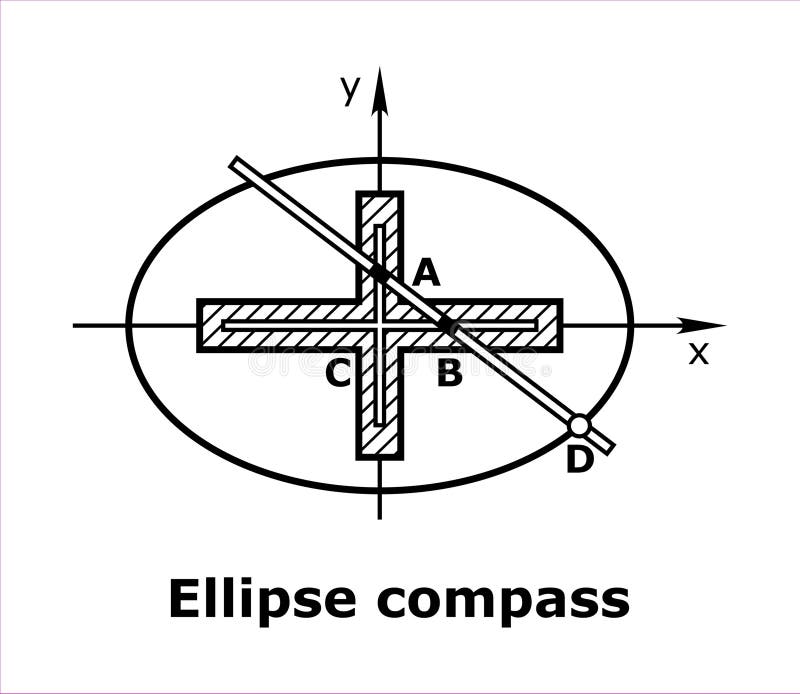
Free with trial Ellipse compass vector illustration isolated. On white. Invariant vectors Ellipse compass vector illustration isolated. On white
Free with trial Illustration of quantum physics, Standard model of elementary particles, quark is a type of elementary particle and a fundamental constituent of matter, Higgs boson. Invariant vectors Illustration of quantum physics, Standard model of elementary particles, quark. Is a type of elementary particle and a fundamental constituent of matter, Higgs
 Sign in