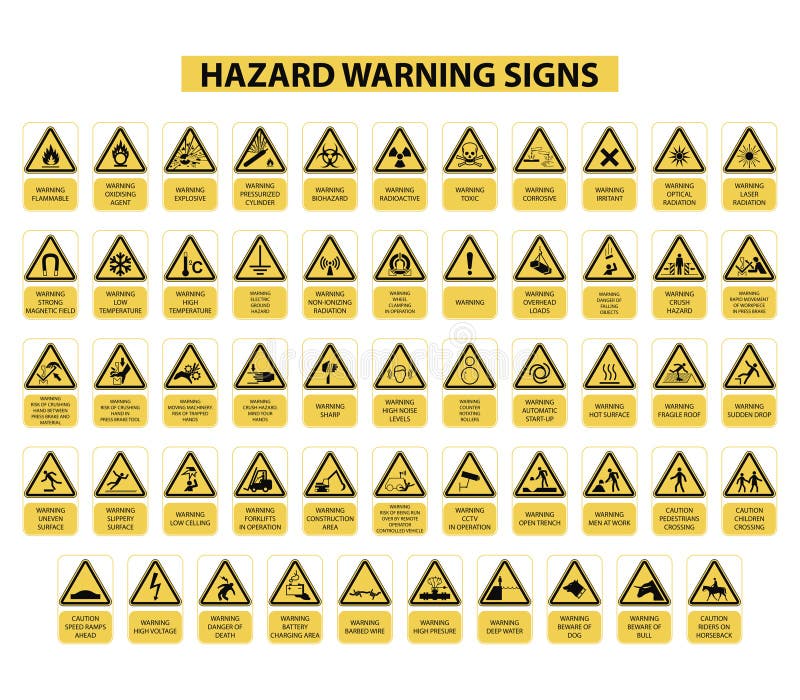
Free with trial Hazard warning signs. Set of hazard warning signs on white background. Regulations vectors Hazard warning signs. Set of hazard warning signs on white background
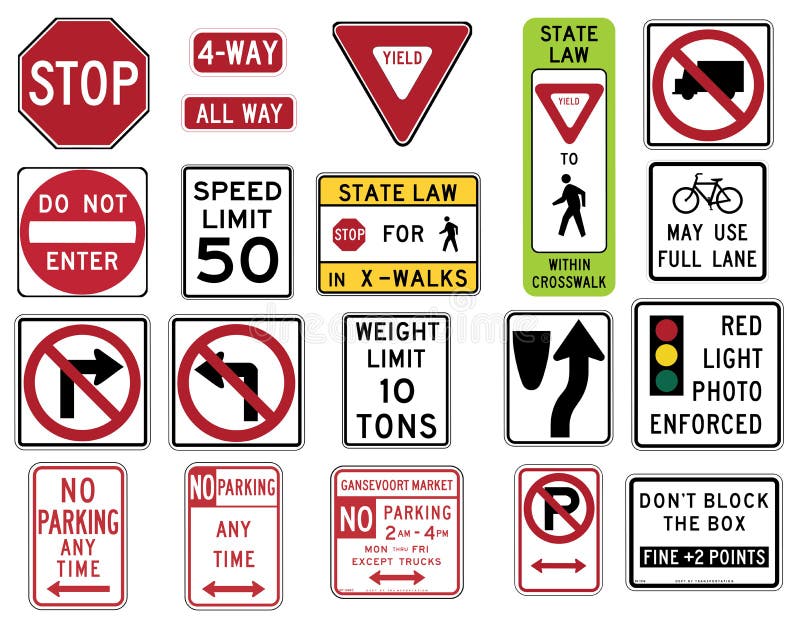
Free with trial Vector Illustration collection of the select Traffic Signs in the United States, isolated on white background. You can find other road signs in my portfolio. EPS file available. In the United States, road signs are, for the most part, standardized by federal regulations, most notably in the Manual on Uniform Traffic Control Devices (MUTCD) and its companion volume the Standard Highway Signs (SHS). There currently are no plans for adopting the Vienna Convention on Road Signs and Signals standards. Twenty-three states along with the District of Columbia and Puerto Rico use the manual without any alterations, 20 states have adopted it in conjunction with a supplemental volume, and seven states have a state version in substantial conformance to the MUTCD. There are also localized versions that are used in large cities such as New York City which use a naming system compatible with the MUTCD and/or state supplement. The MUTCD and SHS establish seven general categories of signs for road and highway use. Included illustrations are select examples of the following MUTCD categories: -- R1 Series STOP and YIELD -- R2 Series Speed Limit -- R3 Series Lane Usage and Turns (Left and Right Turn) -- R4 Regulation of Movement -- R5 Series: Exclusionary -- R7 Series: Parking. Regulations vectors Traffic Signs in the United States - Regulatory Series. Vector Illustration collection of the select Traffic Signs in the United States, isolated on white. Vector Illustration collection of the select Traffic Signs in the United States, isolated on white background. You can find other road signs in my portfolio. EPS file available. In the United States, road signs are, for the most part, standardized by federal regulations, most notably in the Manual on Uniform Traffic Control Devices (MUTCD) and its companion volume the Standard Highway Signs (SHS). There currently are no plans for adopting the Vienna Convention on Road Signs and Signals standards. Twenty-three states along with the District of Columbia and Puerto Rico use the manual without any alterations, 20 states have adopted it in conjunction with a supplemental volume, and seven states have a state version in substantial conformance to the MUTCD. There are also localized versions that are used in large cities such as New York City which use a naming system compatible with the MUTCD and/or state supplement. The MUTCD and SHS establish seven general categories of signs for road and highway use. Included illustrations are select examples of the following MUTCD categories: -- R1 Series STOP and YIELD -- R2 Series Speed Limit -- R3 Series Lane Usage and Turns (Left and Right Turn) -- R4 Regulation of Movement -- R5 Series: Exclusionary -- R7 Series: Parking
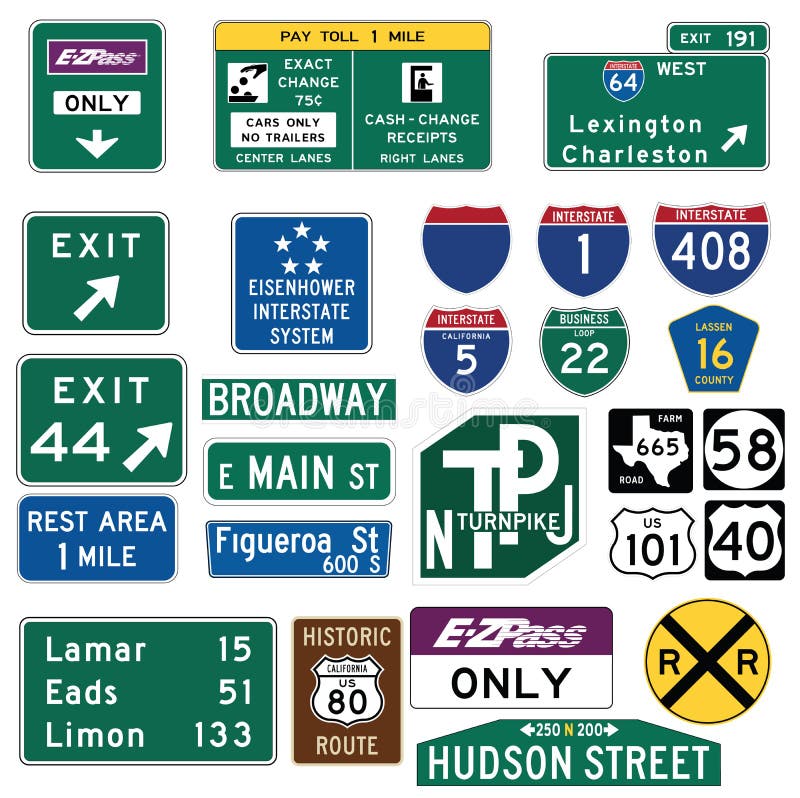
Free with trial Vector Illustration collection of the select Traffic Signs in the United States, isolated on white background. You can find other road signs in my portfolio. EPS file available. Guide signs are essential to direct road users along streets and highways, to inform them of intersecting routes, rnto direct them to cities, towns, villages, or other important destinations, to identify nearby rivers and streams, parks, forests, and historical sites, and generally to give such information as will help them along their way in the most simple, direct manner possible. rnrnIn the United States, road signs are, for the most part, standardized by federal regulations, most notably in the Manual on Uniform Traffic Control Devices (MUTCD) and its companion volume the Standard Highway Signs (SHS). There currently are no plans for adopting the Vienna Convention on Road Signs and Signals standards. Twenty-three states along with the District of Columbia and Puerto Rico use the manual without any alterations, 20 states have adopted it in conjunction with a supplemental volume, and seven states have a state version in substantial conformance to the MUTCD. There are also localized versions that are used in large cities such as New York City which use a naming system compatible with the MUTCD and/or state supplement. The MUTCD and SHS establish seven general categories of signs for road and highway use. rnrnIncluded illustrations are select examples of the MUTCD Guide Signs categories. rn. Regulations vectors Traffic Guide Signs in the United States. Vector Illustration collection of the select Traffic Signs in the United States, isolated on white background. You can. Vector Illustration collection of the select Traffic Signs in the United States, isolated on white background. You can find other road signs in my portfolio. EPS file available. Guide signs are essential to direct road users along streets and highways, to inform them of intersecting routes, rnto direct them to cities, towns, villages, or other important destinations, to identify nearby rivers and streams, parks, forests, and historical sites, and generally to give such information as will help them along their way in the most simple, direct manner possible.rnrnIn the United States, road signs are, for the most part, standardized by federal regulations, most notably in the Manual on Uniform Traffic Control Devices (MUTCD) and its companion volume the Standard Highway Signs (SHS). There currently are no plans for adopting the Vienna Convention on Road Signs and Signals standards. Twenty-three states along with the District of Columbia and Puerto Rico use the manual without any alterations, 20 states have adopted it in conjunction with a supplemental volume, and seven states have a state version in substantial conformance to the MUTCD. There are also localized versions that are used in large cities such as New York City which use a naming system compatible with the MUTCD and/or state supplement. The MUTCD and SHS establish seven general categories of signs for road and highway use.rnrnIncluded illustrations are select examples of the MUTCD Guide Signs categories.rn
Free with trial Banner Standard construction safety concept. Banner work safety concept, hazards, protections, health and regulations with keywords and icons. Regulations vectors Banner Standard construction safety concept. Banner work safety concept, hazards, protections, health and regulations with keywords and icons
Free with trial Signs collection 3 - No sign (+ vector). No sign collection, vector available. Regulations vectors Signs collection 3 - No sign (+ vector). No sign collection, vector available
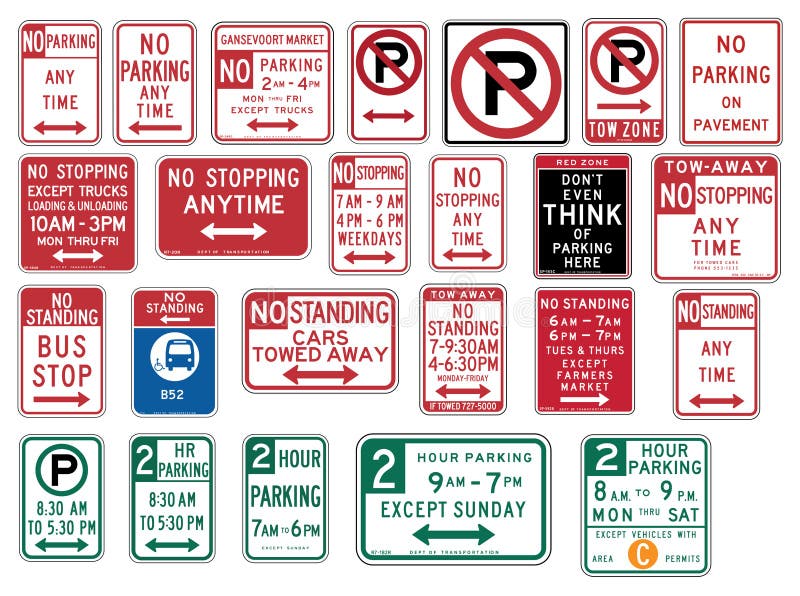
Free with trial Vector Illustration collection of the select Traffic Signs in the United States, isolated on white background. You can find other road signs in my portfolio. EPS file available. rnrnIn the United States, road signs are, for the most part, standardized by federal regulations, most notably in the Manual on Uniform Traffic Control Devices (MUTCD) and its companion volume the Standard Highway Signs (SHS). There currently are no plans for adopting the Vienna Convention on Road Signs and Signals standards. rnTwenty-three states along with the District of Columbia and Puerto Rico use the manual without any alterations, 20 states have adopted it in conjunction with a supplemental volume, and seven states have a state version in substantial conformance to the MUTCD. There are also localized versions that are used in large cities such as New York City which use a naming system compatible with the MUTCD and/or state supplement. The MUTCD and SHS establish seven general categories of signs for road and highway use. rnrnIncluded illustrations are select examples of the following MUTCD categories:rn-- R7 Series: Parkingrnrn. Regulations vectors Traffic Signs in the United States - No Parking. Vector Illustration collection of the select Traffic Signs in the United States, isolated on white background. Vector Illustration collection of the select Traffic Signs in the United States, isolated on white background. You can find other road signs in my portfolio. EPS file available.rnrnIn the United States, road signs are, for the most part, standardized by federal regulations, most notably in the Manual on Uniform Traffic Control Devices (MUTCD) and its companion volume the Standard Highway Signs (SHS). There currently are no plans for adopting the Vienna Convention on Road Signs and Signals standards.rnTwenty-three states along with the District of Columbia and Puerto Rico use the manual without any alterations, 20 states have adopted it in conjunction with a supplemental volume, and seven states have a state version in substantial conformance to the MUTCD. There are also localized versions that are used in large cities such as New York City which use a naming system compatible with the MUTCD and/or state supplement. The MUTCD and SHS establish seven general categories of signs for road and highway use.rnrnIncluded illustrations are select examples of the following MUTCD categories:rn-- R7 Series: Parkingrnrn
Free with trial Flammable liquid. Class 3 transport regulations. Regulations vectors Flammable liquid. Class 3 transport regulations
Free with trial Vector drawn (photo realistic) stop and go signs (vector eps file available). Regulations vectors Stop and Go Signs. Vector drawn (photo realistic) stop and go signs (vector eps file available. Vector drawn (photo realistic) stop and go signs (vector eps file available)
Free with trial Isolated red signage of no entry and restricted area, vector file. Regulations vectors No entry & restricted area. Isolated red signage of no entry and restricted area, vector file. Isolated red signage of no entry and restricted area, vector file.
Free with trial Hazard sign corrosive substances. Hazard label and placard for corrosive substances. Regulations vectors Hazard sign corrosive substances. Hazard label and placard for corrosive substances
Free with trial Signs collection 4 - No sign (+ vector). No sign collection, vector available. Regulations vectors Signs collection 4 - No sign (+ vector). No sign collection, vector available
Free with trial Vector drawn (photo realistic) stop and go signs in the shape of hands (vector eps file available). Regulations vectors Stop and Go Signs. Vector drawn (photo realistic) stop and go signs in the shape of hands (vector eps file available. Vector drawn (photo realistic) stop and go signs in the shape of hands (vector eps file available)
Free with trial Sign for Safety, Health, Environment and Quality. Safety First! Also in vector!. Regulations vectors Safety First - SHE&Q sign - vector. Sign for Safety, Health, Environment and Quality. Safety First! Also in vector. Sign for Safety, Health, Environment and Quality. Safety First! Also in vector!
Free with trial Success stamp. Vector illustration of Success stamp. Regulations vectors Success stamp. Vector illustration of Success stamp
Free with trial Approved stamp. Abstract grunge rubber office stamp with the word approved written inside the stamp. Regulations vectors Approved stamp. Abstract grunge rubber office stamp with the word approved written inside the stamp
Free with trial Park rules sign. Park rules no littering feeding animals sign. Regulations vectors Park rules sign. Park rules no littering feeding animals sign
Free with trial Park rules signs. Park rules no cycling, skating, littering, skate boards. Regulations vectors Park rules signs. Park rules no cycling, skating, littering, skate boards
Free with trial Safety management model business diagram. Diagram of a effective safety management. Vector file also available for extremely sharp and adjustable image. Regulations vectors Safety management model business diagram. Diagram of a effective safety management. Vector file also available for extremely sharp and adjustable image
Free with trial Rejected stamp. Grunge styled rubber stamp rejected. Regulations vectors Rejected stamp. Grunge styled rubber stamp rejected
Free with trial Approved stamp. Grunge styled rubber stamp approved. Regulations vectors Approved stamp. Grunge styled rubber stamp approved
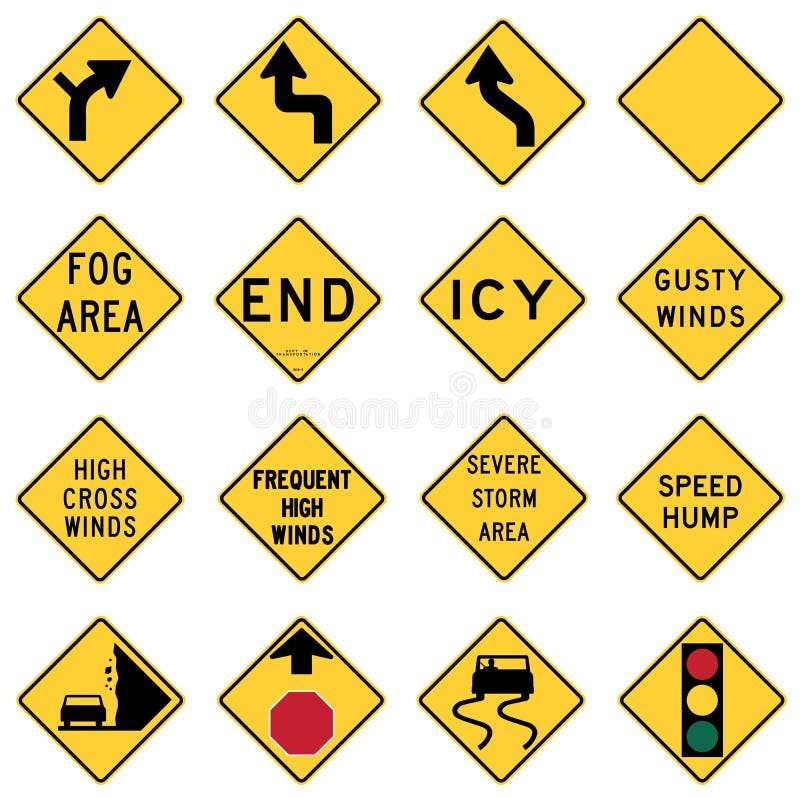
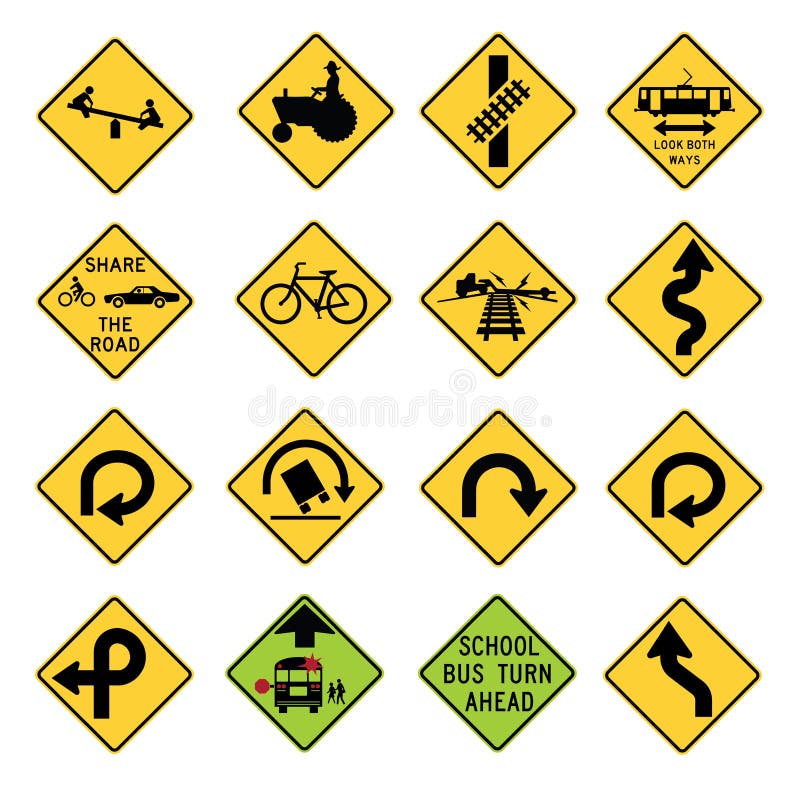
Free with trial Vector Illustration collection of the select Traffic Signs in the United States, isolated on white background. You can find other road signs in my portfolio. EPS file available. Warning signs are found in the W series of the national MUTCD. They highlight existing conditions, such as a curve, school, dead end street, or traffic signal. They can also warn possible danger such as bumps, bicycles, low flying aircraft or emergency vehicles. These signs are either yellow or fluorescent yellow in color and with the exception of a few signs are usually diamond shaped and sometimes have square or rectangular smaller signs or plaques associated with them. Most W series signs can also be found in with orange backgrounds, for temporary use in situations such as construction zones. Some of the temporary use signs are only for use in temporary situations. In the United States, road signs are, for the most part, standardized by federal regulations, most notably in the Manual on Uniform Traffic Control Devices (MUTCD) and its companion volume the Standard Highway Signs (SHS). There currently are no plans for adopting the Vienna Convention on Road Signs and Signals standards. Twenty-three states along with the District of Columbia and Puerto Rico use the manual without any alterations, 20 states have adopted it in conjunction with a supplemental volume, and seven states have a state version in substantial conformance to the MUTCD. There are also localized versions that are used in large cities such as New York City which use a naming system compatible with the MUTCD and/or state supplement. The MUTCD and SHS establish seven general categories of signs for road and highway use. Included illustrations are select examples of the MUTCD Warning Signs categories. Regulations vectors Traffic Warning Signs in the United States. Vector Illustration collection of the select Traffic Signs in the United States, isolated on white background. You. Vector Illustration collection of the select Traffic Signs in the United States, isolated on white background. You can find other road signs in my portfolio. EPS file available. Warning signs are found in the W series of the national MUTCD. They highlight existing conditions, such as a curve, school, dead end street, or traffic signal. They can also warn possible danger such as bumps, bicycles, low flying aircraft or emergency vehicles. These signs are either yellow or fluorescent yellow in color and with the exception of a few signs are usually diamond shaped and sometimes have square or rectangular smaller signs or plaques associated with them. Most W series signs can also be found in with orange backgrounds, for temporary use in situations such as construction zones. Some of the temporary use signs are only for use in temporary situations. In the United States, road signs are, for the most part, standardized by federal regulations, most notably in the Manual on Uniform Traffic Control Devices (MUTCD) and its companion volume the Standard Highway Signs (SHS). There currently are no plans for adopting the Vienna Convention on Road Signs and Signals standards. Twenty-three states along with the District of Columbia and Puerto Rico use the manual without any alterations, 20 states have adopted it in conjunction with a supplemental volume, and seven states have a state version in substantial conformance to the MUTCD. There are also localized versions that are used in large cities such as New York City which use a naming system compatible with the MUTCD and/or state supplement. The MUTCD and SHS establish seven general categories of signs for road and highway use. Included illustrations are select examples of the MUTCD Warning Signs categories.
Free with trial Vector Illustration collection of the select Traffic Signs in the United States, isolated on white background. You can find other road signs in my portfolio. EPS file available. Warning signs are found in the W series of the national MUTCD. They highlight existing conditions, such as a curve, school, dead end street, or traffic signal. They can also warn possible danger such as bumps, bicycles, low flying aircraft or emergency vehicles. These signs are either yellow or fluorescent yellow in color and with the exception of a few signs are usually diamond shaped and sometimes have square or rectangular smaller signs or plaques associated with them. Most W series signs can also be found in with orange backgrounds, for temporary use in situations such as construction zones. Some of the temporary use signs are only for use in temporary situations. In the United States, road signs are, for the most part, standardized by federal regulations, most notably in the Manual on Uniform Traffic Control Devices (MUTCD) and its companion volume the Standard Highway Signs (SHS). There currently are no plans for adopting the Vienna Convention on Road Signs and Signals standards. Twenty-three states along with the District of Columbia and Puerto Rico use the manual without any alterations, 20 states have adopted it in conjunction with a supplemental volume, and seven states have a state version in substantial conformance to the MUTCD. There are also localized versions that are used in large cities such as New York City which use a naming system compatible with the MUTCD and/or state supplement. The MUTCD and SHS establish seven general categories of signs for road and highway use. Included illustrations are select examples of the MUTCD Warning Signs categories. Regulations vectors Traffic Warning Signs in the United States. Vector Illustration collection of the select Traffic Signs in the United States, isolated on white background. You. Vector Illustration collection of the select Traffic Signs in the United States, isolated on white background. You can find other road signs in my portfolio. EPS file available. Warning signs are found in the W series of the national MUTCD. They highlight existing conditions, such as a curve, school, dead end street, or traffic signal. They can also warn possible danger such as bumps, bicycles, low flying aircraft or emergency vehicles. These signs are either yellow or fluorescent yellow in color and with the exception of a few signs are usually diamond shaped and sometimes have square or rectangular smaller signs or plaques associated with them. Most W series signs can also be found in with orange backgrounds, for temporary use in situations such as construction zones. Some of the temporary use signs are only for use in temporary situations. In the United States, road signs are, for the most part, standardized by federal regulations, most notably in the Manual on Uniform Traffic Control Devices (MUTCD) and its companion volume the Standard Highway Signs (SHS). There currently are no plans for adopting the Vienna Convention on Road Signs and Signals standards. Twenty-three states along with the District of Columbia and Puerto Rico use the manual without any alterations, 20 states have adopted it in conjunction with a supplemental volume, and seven states have a state version in substantial conformance to the MUTCD. There are also localized versions that are used in large cities such as New York City which use a naming system compatible with the MUTCD and/or state supplement. The MUTCD and SHS establish seven general categories of signs for road and highway use. Included illustrations are select examples of the MUTCD Warning Signs categories.
Free with trial Office signs. Construction industry and office signs individually layered. Regulations vectors Office signs. Construction industry and office signs individually layered
Free with trial Park Rules with symbols. Park Rules carry skates and skateboards, walk bikes and scooters, no littering, all dogs on lead. Regulations vectors Park Rules with symbols. Park Rules carry skates and skateboards, walk bikes and scooters, no littering, all dogs on lead
Free with trial No dog sign, vector illustration. Regulations vectors No Dog Sign. Vector illustration. No dog sign, vector illustration
Free with trial Original grunge rubber stamp. An illustration of original abstract grunge rubber stamp. Regulations vectors Original grunge rubber stamp. An illustration of original abstract grunge rubber stamp
Free with trial Business Ethics Outline Icon Set w Honesty, Integrity, Commitment, & Decision. Regulations vectors Business Ethics Outline Icon Set w Honesty, Integrity, Commitment, & Decision. Business Ethics Outline Icon Set with Honesty, Integrity, Commitment, and Decision
Free with trial Approved abstract grunge rubber stamp. An illustration of approved abstract grunge rubber stamp. Regulations vectors Approved abstract grunge rubber stamp. An illustration of approved abstract grunge rubber stamp
Free with trial Illustration of Retro styled Abstract Businessman caught up in bureaucratic red tape. Regulations vectors Abstract Businessman caught in Red Tape. Illustration of Retro styled Abstract Businessman caught up in bureaucratic red tape. Illustration of Retro styled Abstract Businessman caught up in bureaucratic red tape.
Free with trial 102 important construction site and building site safety warning signage, icons and symbols. Building site, construction environments, Hazard warning attention sign, Industry Health and Safety Icon collection. Regulations vectors Building site, construction environments, Hazard warning attention sign, Industry Health and Safety Icon collection. 102 important construction site and. 102 important construction site and building site safety warning signage, icons and symbols. Building site, construction environments, Hazard warning attention sign, Industry Health and Safety Icon collection.
Free with trial Contract documents pile vector illustration, flat cartoon stack of agreements document with signature and approval stamp, concept of paperwork, business doc. Regulations vectors Contract documents pile vector illustration, stack of agreements document with signature and approval stamp. Contract documents pile vector illustration, flat. Contract documents pile vector illustration, flat cartoon stack of agreements document with signature and approval stamp, concept of paperwork, business doc
Free with trial Swimming pool rules. Icons and symbol for pool. Regulations vectors Swimming pool rules. Set of icons and symbol for pool. Swimming pool rules. Icons and symbol for pool. Swimming pool rules. Icons and symbol for pool.
Free with trial Set of safety and health protection signs. Mandatory construction and industry signs. Collection of safety equipment. Protection on work. Vector illustration. Regulations vectors Set of safety and health protection signs. Mandatory construction and industry signs. Collection of safety equipment. Protection on work. Vector illustration
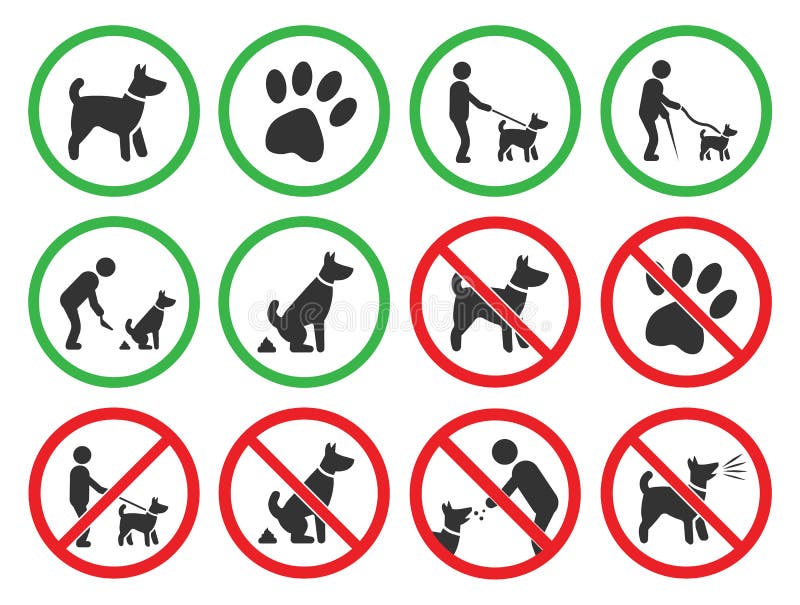
Free with trial Dog friendly and dog restriction signs, dog prohibited icons. No dogs signs, dogs allowed and prohibited icons. Regulations vectors Dog friendly and dog restriction signs, dog prohibited icons. No dogs signs, dogs allowed and prohibited icons
Free with trial Stop sign, set. Vector illustration. Web icon. Traffic sign. Stop icon. Regulations vectors Stop sign, set. Vector illustration. Web icon. Traffic sign. Stop icon
Free with trial Blue mandatory set of safety equipment signs in white pictogram on blue background. Wear personal protective equipment , rules and regulations on construction site signage. Regulations vectors Blue mandatory set of safety equipment signs in white pictogram. On blue background. Wear personal protective equipment , rules and regulations on construction
Free with trial Rules vector illustration. Flat tiny regulations checklist persons concept. Restricted graphic writing with law information. Society control guidelines and strategy for company order and restrictions. Regulations vectors Rules vector illustration. Flat tiny regulations checklist persons concept. Restricted graphic writing with law information. Society control guidelines and
Free with trial Regulatory compliance flat isometric vector concept. Business people are discussing steps to comply with relevant laws, policies, and regulations. Regulations vectors Regulatory compliance flat isometric vector. Regulatory compliance flat isometric vector concept. Business people are discussing steps to comply with relevant. Regulatory compliance flat isometric vector concept. Business people are discussing steps to comply with relevant laws, policies, and regulations.
Free with trial Regulatory compliance flat isometric vector concept. Businessmen are discussing steps to comply with relevant laws, policies, and regulations. Regulations vectors Regulatory compliance flat isometric vector concept. Businessmen are discussing steps to comply with relevant laws, policies, and regulations
Free with trial Vector drawn (photo realistic) yes and no signs in the shape of hands (vector eps file available). Regulations vectors Yes and No Signs. Vector drawn (photo realistic) yes and no signs in the shape of hands (vector eps file available. Vector drawn (photo realistic) yes and no signs in the shape of hands (vector eps file available)
Free with trial Football judge. Blowing a whistle. Regulations vectors Football judge. Blowing a whistle
Free with trial Swimming pool rules. Public and private pools rules to ensure health, safety and to provide enjoyable recreation. Vector flat style cartoon illustration isolated on white background. Regulations vectors Swimming pool rules. Public and private pools rules to ensure health, safety and to provide enjoyable recreation. Vector flat style cartoon illustration
Free with trial Mandatory construction and industry signs. Collection of safety equipment. Protection on work. Vector illustration. Regulations vectors Set of safety and health protection signs. Mandatory construction and industry signs. Collection of safety equipment. Protection on work. Vector illustration. Mandatory construction and industry signs. Collection of safety equipment. Protection on work. Vector illustration.
Free with trial Electrician worker cartoon an industrial power. Regulations vectors Electrician. Electrician worker cartoon an industrial power. Electrician worker cartoon an industrial power.
Free with trial Completed stamp. Grunge styled rubber stamp completed. Regulations vectors Completed stamp. Grunge styled rubber stamp completed
Free with trial Prohibition signs. Set of prohibition signs on white background. Regulations vectors Prohibition signs. Set of prohibition signs on white background
Free with trial Man in a low-power house. Hand drawn cartoon characters - man in a low-power house. Regulations vectors Man in a low-power house. Hand drawn cartoon characters - man in a low-power house
Free with trial Banner `Standard Operating Procedure`. SOP is a set of step-by-step instructions compiled by an organization to help workers carry out complex routine operations. Vector Illustration Concept with keywords, letters and icons. Regulations vectors SOP, Standard Operating Procedure. Vector Concept with icons. Banner `Standard Operating Procedure`. SOP is a set of step-by-step instructions compiled by an. Banner `Standard Operating Procedure`. SOP is a set of step-by-step instructions compiled by an organization to help workers carry out complex routine operations. Vector Illustration Concept with keywords, letters and icons
Free with trial Denied skamp. Abstract grunge rubber stamp with the text denied. Regulations vectors Denied skamp. Abstract grunge rubber stamp with the text denied
Free with trial No littering sign. On white background. Regulations vectors No littering sign. On white background
Free with trial Restriction sign. Shiny metallic restriction sign - vector illustration. Regulations vectors Restriction sign. Shiny metallic restriction sign - vector illustration
Free with trial Office stamp with the word approved. Grunge rubber office stamp with the word approved. Regulations vectors Office stamp with the word approved. Grunge rubber office stamp with the word approved
Free with trial Signs. Various signs on products, vector. Regulations vectors Signs. Various signs on products, vector
Free with trial Approved stamp. Green grunge rubber office stamp with the word approved written inside. Regulations vectors Approved stamp. Green grunge rubber office stamp with the word approved written inside
Free with trial Football icons, referee, helmet, and whistle. Football icons, helmet, referee, and whistle on white background. Regulations vectors Football icons, referee, helmet, and whistle. Football icons, helmet, referee, and whistle on white background
Free with trial Ok abstract grunge rubber stamp background. Vector illustration of Ok abstract grunge rubber stamp background. Regulations vectors Ok abstract grunge rubber stamp background. Vector illustration of Ok abstract grunge rubber stamp background
Free with trial Park Rules with red symbols. Park Rules no skates, bikes, scooters, no littering, no dogs off lead. Regulations vectors Park Rules with red symbols. Park Rules no skates, bikes, scooters, no littering, no dogs off lead
Free with trial Stamps approved and rejected. Vector rubber stamps approved and rejected. Regulations vectors Stamps approved and rejected. Vector rubber stamps approved and rejected
Free with trial Stop sign, set. Vector illustration. Regulations vectors Stop sign, set. Vector illustration
Free with trial Vector Driving School Concept. On white background. Regulations vectors Vector Driving School Concept. On white background
Free with trial Mandatory signs. Set of mandatory signs on white background. Regulations vectors Mandatory signs. Set of mandatory signs on white background
Free with trial Mandatory signs. Set of mandatory signs on white background. Regulations vectors Mandatory signs. Set of mandatory signs on white background
Free with trial Flat Compliance Set. Compliance design concept set with regulations policies and requirements flat icons isolated vector illustration. Regulations vectors Flat Compliance Set. Compliance design concept set with regulations policies and requirements flat icons isolated vector illustration
Free with trial No pets symbol. No Dogs and No cats Icon. Dogs not allowed Icon,Cats not allowed icon. Prohibition Sign. Regulations vectors No pets symbol. No Dogs and No cats Icon.Dogs not allowed Icon,Cats not allowed icon.Prohibition Sign
Free with trial A set of stickman pictogram representing a set of basketball referee hand signals for the basketball game. Regulations vectors Basketball Referees Officials Hand Signals Cliparts. A set of stickman pictogram representing a set of basketball referee hand signals for the basketball game. A set of stickman pictogram representing a set of basketball referee hand signals for the basketball game.
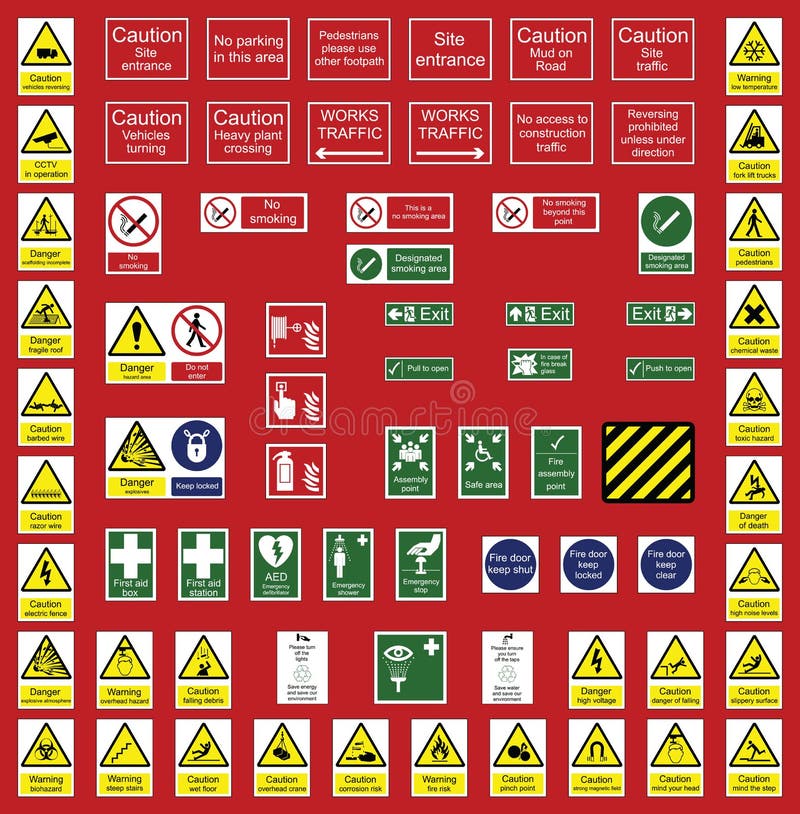
Free with trial Hazard warning signs. Set of hazard warning signs on white background. Regulations vectors Hazard warning signs. Set of hazard warning signs on white background
Free with trial Recycling codes infographic for packaging labeling, waste disposal and industrial reprocessing, environmental care concept. Regulations vectors Industrial recycling codes infographic. Recycling codes infographic for packaging labeling, waste disposal and industrial reprocessing, environmental care. Recycling codes infographic for packaging labeling, waste disposal and industrial reprocessing, environmental care concept
Free with trial Health and safety. Sandwich board with construction health and safety message. Regulations vectors Health and safety. Sandwich board with construction health and safety message
Free with trial Stop sign. Illustration of a Stop sign. Regulations vectors Stop sign. Illustration of a Stop sign
Free with trial Vector High quality illustration of stop sign and go sign isolated on white background. Official Vienna convention international color and size - editable vector eps file available. Regulations vectors Stop go sign. Vector High quality illustration of stop sign and go sign isolated on white background. Official Vienna convention international color and size. Vector High quality illustration of stop sign and go sign isolated on white background. Official Vienna convention international color and size - editable vector eps file available.
Free with trial High noise area, wear ear protection - caution sign. High noise area, wear ear protection, suitable for caution sign. Regulations vectors High noise area, wear ear protection - caution sign. High noise area, wear ear protection, suitable for caution sign
Free with trial Guidelines business guide standard document company. Vector. Regulations vectors Guidelines business guide standard document company. Vector
Free with trial Set of vector business or finance icons and concepts in mono thin line style. Regulations vectors Set of vector business or finance icons and concepts in mono thin line style.
Free with trial Great illustration of Retro styled Abstract Businessman caught up in a bureaucratic chain and ball. Regulations vectors Abstract Businessman locked in a Ball and Chain. Great illustration of Retro styled Abstract Businessman caught up in a bureaucratic chain and ball. Great illustration of Retro styled Abstract Businessman caught up in a bureaucratic chain and ball.
Free with trial Construction Industry Icons. Construction Industry Health and Safety Icons isolated on blue background. Regulations vectors Construction Industry Icons. Construction Industry Health and Safety Icons isolated on blue background
Free with trial No Entry Sign. Illustration Of No Entry And Stop Traffic Signs Isolated On White. Regulations vectors No Entry Sign. Illustration Of No Entry And Stop Traffic Signs Isolated On White
Free with trial Business Ethics Solid Icon Set with Honesty, Integrity, Commitment, and Decision. Regulations vectors Business Ethics Solid Icon Set with Honesty, Integrity, Commitment, and Decision. Business Ethics Solid Icon Set with Honesty, Integrity, Commitment, & Decision
Free with trial Road vest for safe work. Safety clothing with reflective stripes. Vector illustration. Front and back side. Orange and green security waistcoats. Blank uniform template for fashion design. Regulations vectors Road vest for safe work. Front and back side. Road vest for safe work. Safety clothing with reflective stripes. Vector illustration. Front and back side. Orange. Road vest for safe work. Safety clothing with reflective stripes. Vector illustration. Front and back side. Orange and green security waistcoats. Blank uniform template for fashion design.
 Sign in